Category Archives: Alcohol recovery

stop-drinking-alcohol

Alcohol solution with over the counter medication
Alcohol solution

Alcohol solution with over the counter medication can not in any way be used together

Alcohol solution with over the counter medication: Beware Mixing Alcohol with other substances

Alcohol solutions with other related drug interactions including medications have serious health effects and must be avoided at all cost. Ironically, many in ignorance find mixing alcohol with other substances a normal thing to do. This has exposed them to great dangers and so as experts from the AWAREmed health and wellness resource center under the leadership of doctor Dalal Akoury MD, we want to use this platform in creating awareness and also offer solutions to everyone struggling with alcoholism. Taking any alcohol solution whether it is mixed with over the counter medications, prescriptions or otherwise, has severe consequences. And as a way of finding solutions, doctor Dalal Akoury founded this health facility to primarily transforming each individual’s life through increasing awareness about health and wellness and by empowering individuals to find their own inner healing power.

Besides that it will interest you to note that doctor Akoury’s practice focuses on personalized medicine through healthy lifestyle choices that deal with primary prevention and underlying causes instead of patching up symptoms. With this expertise, you can never go wrong with doctor Akoury, and all you need to do is to call her on telephone number 843 213 1480 for the commencement of your treatment program. The following are some common Over the counter (OTC) and prescriptions medications and a few other substances which you should be very cautious about mixing with alcohol.

Alcohol solution with over the counter medication: Aspirin

For some reason we are not quite sure of aspirin appears to block the action of alcohol dehydrogenase. What this means is that if you take aspirin before drinking you will become much more intoxicated on a much smaller dose of alcohol than usual. It is generally recommended that you do not take aspirin for around six hours before drinking alcohol. If you have taken aspirin before drinking be cautious and try to limit your alcohol intake as much as possible.

Cayenne pepper: Cayenne pepper dilates the blood vessels and apparently leads higher BACs and more exposure of the brain to alcohol. In short, if you drink alcohol while ingesting a lot of cayenne pepper you will become much drunker than usual. Avoid red pepper vodka!

Tylenol (acetaminophen, paracetamol): Even by itself Tylenol can cause liver failure. Combining Tylenol with alcohol is a horrible one-two punch to the liver. If you love your liver then don’t take Tylenol or Tylenol PM or anything else containing acetaminophen with alcohol or when you have hangover. Else you might as well fry up your liver with onions!!

Ambien: mixing alcohol with Ambien is just about a sure recipe for a blackout or a brownout. People who mix the two also often report sleepwalking or even sleep eating. It’s better to take one or the other and not mix them together.

Narcotic painkillers: Another recipe for blackout and disturbed behavior. Avoid mixing alcohol with Percocet, Percodan, Vicodin, oxycontin, codeine, morphine or any other narcotic painkillers.

Benadryl (diphenhydramine), Dramamine (dimenhydrinate), and Unisom Nighttime (doxylamine): Mixing alcohol with any antihistamine which causes drowsiness will definitely enhance the feeling of drowsiness many times over. All OTC sleep aids consist of one of the three above named antihistamines. Mixing them with alcohol is not medically dangerous, but beware of the added drowsiness.

The effect of smoking tobacco (Nicotine): Cigarette smoking slows gastric emptying and as a consequence delays alcohol absorption.

Alcohol solution with over the counter medication: Beware Mixing Alcohol with other substances

http://www.I-AM-I.com/wp-admin

Facebooktwitterpinterestlinkedin
Your bottle of death

Alcohol ingestion routes and the dangers

Alcohol ingestion routes

Alcohol ingestion routes and the dangers can come with severe symptoms which when not address could be fatal.

Alcohol ingestion routes and the dangers: Alcohol without liquid

The only normal route of alcohol ingesting is drinking through the mouth. This is the commonly known route but it is certainly not the only route possible ads doctor Dalal Akoury MD, President, and founder of AWAREmed health and wellness resource center. In her decades of practice, doctor Akoury registers that there are many other exotic routes through which alcohol can be used in different occasions. In other words, we are saying that besides the common route, Alcohol can also be inhaled, absorbed through the skin, injected, or given as an enema. This is what we want to discuss and with the help of doctor Akoury and her team of experts, we will be home by the end of this discussion. Let us now consider each of these methods:

Inhalation

Alcohol without Liquid (AWOL) is an alcohol inhalation device that has been released in the US and the UK. AWOL’s manufacturers claim that when alcohol is vaporized and inhaled it can lead to intoxication as much as 10 times as quickly as drinking and allows one to sober up with no hangover in an equally rapid time frame. Doctors are still debating the safety of AWOL. At least 22 states in the US have banned AWOL.

Injection

Some scientific researchers give alcohol injections to research subjects when they wish to bypass the stomach. It was the comparison of the effects of injected alcohol with orally ingested alcohol which led scientists to conclude that women have less alcohol dehydrogenase in their stomachs than men do. Self-administration of alcohol by injection is extremely dangerous and should never be attempted. The risk of death by alcohol poisoning is extremely high.

Transdermal

Alcohol can also be absorbed through the skin although this is quite a slow and impractical method of ingesting it.

Alcohol ingestion routes and the dangers: Alcohol enema

This is another rather dangerous and sometimes deadly form of alcohol administration. If the internet is to be believed then alcohol enemas are not uncommon at sex parties. A beer enema might be safe enough. However, the simple fact is that alcohol is absorbed very rapidly through the large intestine and the rectum and there are no enzymes here to break it down. Thus the same dose of alcohol given by enema will produce a much higher BAC than if one drinks it. There was a famous case of death by sherry enema in Texas where the wife was acquitted of murder charges. And a vodka enema is silent but deadly for sure.

Finally, having known the methods of administering alcohol into the body, we want to make one point clear. There is the myth that some methods of administration have the capabilities of reducing the effects of alcohol. This is not true and the dangers still remain. Therefore, if you or any of your loved ones is struggling with alcoholism, it may not matter the modes of administration, the health consequences remain the same and could be out of hand if action is not taken in good time. It will interest you to note that, doctor Akoury created this facility to primarily transform each individual’s life through increasing awareness about health and wellness and by empowering individuals to find their own inner healing power. Her practices also focus on personalized medicine through healthy lifestyle choices that deal with primary prevention and underlying causes instead of patching up symptoms making her the best option for all your addiction solution needs.

Alcohol ingestion routes and the dangers: Alcohol without liquid

http://www.integrativeaddictionconference.com/wp-admin

Facebooktwitterpinterestlinkedin
Alcohol kills

Understanding alcohol metabolism stability

Understanding alcohol metabolism

Understanding alcohol metabolism stability with a view of taking timely action

Understanding alcohol metabolism stability: Why alcohol has a steady state metabolism rather than a half life

For us to get the facts right in understanding alcohol metabolism stability, we need to address the substance wholesomely. That is to say, when a drug like valium is broken down by the human body the resultant metabolites are harmless. It is for this reason that drugs like valium are broken down as quickly as the body can process them–and hence they have a half-life. The half-life of valium is 35 hours on the average. This means that if you take a 10 mg dose of valium, then 35 hours later half of it will have been metabolized and only 5 mg will remain. In another 35 hours half of this will be metabolized and only 2.5 mg will remain and so on explains doctor Dalal Akoury MD, President and founder of AWAREmed health and wellness resource center. When we plot the metabolism of valium on a graph we get an exponential curve–in other words–drugs which have a half-life have an exponential rate of decay. Chemists refer to this as a First Order Reaction.

When it comes to alcohol, it is all a different reaction. That is because alcohol shows a steady state metabolism not an exponential metabolism. The body of the average human metabolizes around 13 ml of alcohol per hour regardless. When we plot the metabolism of alcohol on a graph we get a straight line–in other words the rate of decay of alcohol is linear. Chemists refer to this as a Zero Order Reaction. The reason why alcohol has a steady state metabolism rather than a half-life metabolism is because the primary decay product of alcohol metabolism–acetaldehyde–is poisonous. The body must eliminate the acetaldehyde produced by the breakdown of alcohol before any more alcohol can be processed in order to avoid acetaldehyde poisoning. This slows down the rate of alcohol metabolism to a Zero Order Reaction rather than a First Order Reaction.

Understanding alcohol metabolism stability: Why do humans have a way to break down alcohol?

Practically every animal from the fruit fly to the elephant has a way to break down ethyl alcohol because ethyl alcohol is found everywhere by nature. Every time you eat a piece of fresh fruit, drink a glass of fresh orange juice, or have a slice of freshly baked bread, chances are that you are getting trace amounts of alcohol along with it. It is not uncommon to see intoxicated birds which have eaten fermented fruit. Monkeys are known to seek out fermented fruit for the intoxicating effect and Indian elephants have been known to break into breweries or wineries to drink up what is stored there.

Not only are we constantly ingesting alcohol along with the food we eat, our own bodies produce alcohol as a part of the digestive process. Our digestive tracts contain millions of micro-organisms which are necessary for us to properly digest our food. Among these micro-organisms are yeasts which produce alcohol from sugars within our own bodies.

With alcohol so omnipresent in nature it is necessary that animals have a way to break alcohol down, otherwise it would just accumulate in the body and no animal could function properly because the animals would always be constantly intoxicated. Other alcohols such as methyl alcohol (wood alcohol) and isopropyl alcohol (rubbing alcohol) do not normally occur in nature. This is why we do not have a mechanism to break them down and why they are poisonous. That then explains why we all need help to have a free state of mind in dealing with alcohol addiction. Doctor Akoury and her team of experts will be very helpful should you schedule an appointment with them now.

Understanding alcohol metabolism stability: Why alcohol has a steady state metabolism rather than a half life

http://regenerativepotential.com/wp-admin


Facebooktwitterpinterestlinkedin
Dopamine Rush

Lyme disease links between pain and addiction

Lyme disease links

Lyme disease links between pain and addiction alongside stress are a poor combination for any one to associate with

Lyme disease links between pain and addiction: Stressful obstructions

People who struggle with stressful medical conditions like Lyme disease links between pain, addiction and stress are more vulnerable to substance abuse this is according to the scientists at the National Institute of Health (NIH). Besides that, other statistics shows that individuals with chronic pain experience substance abuse rates at two-to-four times that of the general population. And from decades of experience, doctor Dalal Akoury MD, President and founder of AWAREmed health and wellness recourse center reiterates that there are several factors explaining their susceptibility some of which may include:

  • Ongoing need for medication
  • Ongoing health problems
  • Societal enabling
  • Lack of identification of potential problems

Stress is another factor that can predispose individuals who live with chronic pain to addiction. Researchers have identified a correlation between stress and substance abuse. Important facts about this link include:

  • Stress is a major contributor to the initiation and continuation of substance abuse.
  • Children who are exposed to severe stress are more vulnerable to substance abuse in adulthood.
  • 30-60% of individuals with substance use disorders meet the criteria for comorbid PTSD.
  • Patients with substance use disorders tend to suffer from more severe PTSD symptoms than PTSD patients without substance use disorders.
  • Animals that are not previously exposed to illicit substances become more vulnerable to drug self-administration when stressed.
  • Many of the same Neuro-circuits that respond to drugs also respond to stress.

Stress increases the release of corticotrophin-releasing factor (CRF), a hormone that catalyzes biological responses to stressors such as increased heart rate and metabolism. Abusing drugs also increases CRF levels and thereby heightens danger of relapse.

Stress also triggers the fight-or-flight moderating amygdala. When the amygdala perceives threats, it responds irrationally and hijacks the individual’s ability to think clearly. For people in recovery who stay sober by making wise choices, this emotional takeover can impair judgment and make resisting drugs harder.

There is yet another way that stress packs a double punch for people who suffer from Lyme disease. It exacerbates pain. A research team from Carnegie Mellon University found that chronic psychological stress is associated with the ability to regulate the body’s inflammatory response. This can lead to the development or progression of disease.

Lyme disease links between pain and addiction: Coping with stress

Mastering stress reduction skills is an important part of overall health and sobriety. In treatment many people find ways to incorporate relaxation strategies into daily life. Several include the following:

  • Singing
  • Massage
  • Spending time outdoors
  • Journaling
  • Yoga
  • Adopting a dog
  • Listening to music
  • Taking a walk
  • Drawing
  • Soaking in a hot bath

Other stress-management skills and techniques frequently taught in recovery programs include the following:

  • Avoiding hunger, anger, loneliness and fatigue
  • Engaging in community service
  • Journaling thoughts and feelings
  • Practicing positive thinking

Finally, with all these sufferings, it is only fair that you get help immediately and that is why doctor Akoury founded this facility to help you through your recovery process. All you need, is to reach out for her by scheduling an appointment today and all your concerns will be addressed professionally.

Lyme disease links between pain and addiction: Stressful obstructions

http://www.integrativeaddictionconference.com/wp-admin

Facebooktwitterpinterestlinkedin
lyme-disease-pictures

Lyme disease obstructions of health and wellness

Lyme disease obstructions

Lyme disease obstructions of health and wellness if not addressed can be very irritating

Lyme disease obstructions of health and wellness: Addiction and Lyme disease

There is no doubt that everyone desire is to live life to the fullest enjoying every bit of it. In an attempt of achieving this, we often meet several obstacles on the way. Dealing with these obstacles is the biggest challenge humanity goes through and as a result of this, experts at AWAREmed health and wellness resource center under the leadership of doctor Dalal Akoury MD, are making every effort in ensuring that all the life hindrances are avoided or put under manageable controls hence the choice of this topic Lyme disease obstructions of health and wellness. That is to say, Lyme disease is one of the hindrances we experience in the process of seeking for the full enjoyment of life. It complicates life, even more, when it causes addiction into the patient system. This complication and how addiction is involved will form the basis of our discussion in this article. For us to do this it will be important that we have the general overview of Lyme disease, its causes, and even treatment.

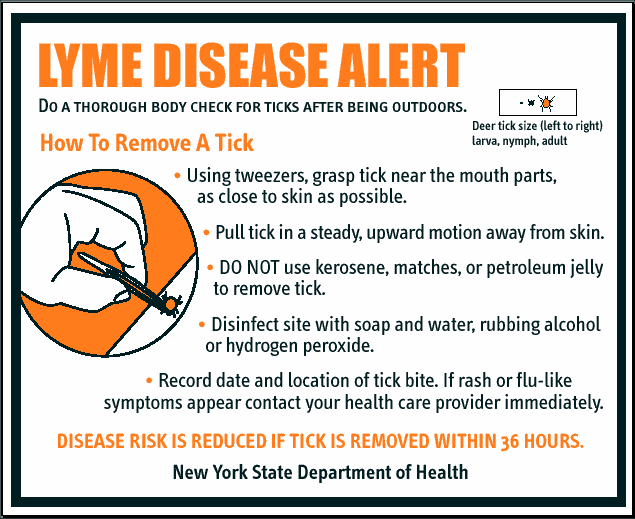
Lyme disease is caused by Borrelia burgdorferi, which is carried by Ixodes scapularis or Ixodes pacificus ticks. These ticks are primarily found in the northeast, northwest and upper Midwest of the United State. However, such ticks are also found globally in bushy areas and their effects are the same for all patients. We can avoid Lyme disease by staying away from tick-infested areas. If this is not possible for whatever reason, outdoor enthusiasts should wear long pants tucked into their socks and a long-sleeved shirt tucked into their pants. In the event a tick bites you, it should be removed carefully without delay by inserting tweezers between the tick and the skin and lifting gently. Normally such tricks will have to be attached to the skin for at least 48 hours to transmit disease. When neurologic symptoms occur, they are probably triggered by the direct action of the bacterium and an immunologic reaction. People who live with Lyme disease face a daily battle marked by fatigue and pain. Ordinary tasks can become challenging and stressful leading some individuals resulting to self-medication with drugs and alcohol which are very addictive.

Lyme disease obstructions of health and wellness: Symptoms of Lyme disease

First recognized in 1975 when a group of children living near Lyme, Connecticut became ill with arthritis, Lyme disease has spread to nearly all 50 states and affects approximately 16,000 individuals each year. Within a few days to several weeks after being bitten by an infected tick, 80% of people develop a red, circular rash around the bite according to experts at the Mayo Clinic. The center of the rash may clear as it grows giving the appearance of a bull’s-eye pattern. The rash may feel warm, but it is usually not painful or itchy. Other symptoms in the early stage of Lyme disease may include the following:

  • Fatigue
  • Fever
  • Chills
  • Joint pain
  • Muscle aches
  • Headaches
  • Stiff necks
  • Swollen lymph nodes

Later stages of Lyme disease can become very serious resulting in debilitating and chronic symptoms including:

  • Arthritis in the arms and legs
  • Memory loss
  • Numbness in hands, arms, legs, and feet

Lyme disease is usually treated with antibiotics taken for three to four weeks. Antibiotics are usually taken by mouth, but in severe or advanced cases of Lyme disease, they may be given by injection. If treatment begins at the early stage of the disease, a complete cure is likely and any delay, recovery may take longer and symptoms may last for months or even years which is why seeking professional redress with doctor Dalal Akoury is very important for you.

Lyme disease obstructions of health and wellness: Addiction and Lyme disease

http://www.awaremednetwork.com/

Facebooktwitterpinterestlinkedin