Category Archives: Act Now

Addiction

Addiction withdrawal fears and sustainable health

Addiction withdrawal fears

Addiction withdrawal fears and sustainable health can never be compatible in any way

Addiction withdrawal fears and sustainable health: Good health for wealth

Fear of withdrawal is one of the fundamental forces at play in the power of addiction. After long use of the choice drug, a lot of things happen not just to the brain but body tissues also develop dependence. From the decades of experience in dealing with addiction matters, doctor Dalal Akoury who is also the MD, President and founder of AWAREmed health and wellness resource center reiterates that, the physical signs and symptoms of withdrawal are usually associated with abrupt stop of usage including tremors, sleeplessness, diarrhea, anxiety, sweating, loss of appetite, up to hallucinations and seizures in severe cases.

Substance Dependency and Relapse

Trigger-induced craving is one of the most frequent causes of drug use relapses, even after long periods of abstinence. Environmental triggers help explain why re-entry to one’s community can be so difficult for addict leaving the controlled environments of an addiction treatment Centre.

Addiction withdrawal fears and sustainable health: How energy healing is beneficial in addiction?

Energy healing helps to increase the level of energy in the body and leaves you feeling relaxed, energized and in a positive state of mind. It unblocks energy and re-establishes energy flow in internal organs which stimulates, nourish and replenish them. In doing so it improves the state of internal organs, assisting everything from digestion, absorption, blood circulation and energy production activities.

In order to truly help someone who is suffering from addiction, energy healing involves seeking the tools that will help you attract your desires and find your personal power to manifest wellbeing on all levels and help you overcome the underlying problem that is causing addiction. Energy healing is, therefore, beneficial in addiction control and elimination by executing the following:

  • Increasing feeling of relaxation
  • Reducing intensity of withdrawal symptoms
  • Improving sleep patterns
  • Freeing blocked energy in the body

How many treatments will one need?

The number of energy healing treatments required to treat addiction will differ between individuals patient. Research have indicated that meditation can help decrease substance use and relapse. Meditation will allow for a reflection on all repressed feelings and events, providing the space for them to come to the surface, enabling healing process to take place by shifting brain activities from the stress-prone brain to more calming. Meditation will be effective when learned from the instructor than from the book, tape or just sitting and focusing on your breath. By learning to meditate correctly, the increased awareness and mindfulness of meditation helps you avoid thoughts of substance usage, which can surface during recovery. Finally, even as you go that direction, it is equally important to seek professional help from the experts at AWAREmed health center from time to time and all your concerns will be addressed professionally.

Addiction withdrawal fears and sustainable health: Good health for wealth

http://regenerativepotential.com/wp-admin


Facebooktwitterpinterestlinkedin
Reward Deficieny syndrome

Reward deficiency syndrome and brain disease

Reward deficiency syndrome

Reward deficiency syndrome and brain disease. In fact, it is the reward deficiency syndrome that causes the compulsive use of alcohol and drugs that help to feel good, at least temporarily

Reward deficiency syndrome and brain disease: Rebuilding Neurotransmitter

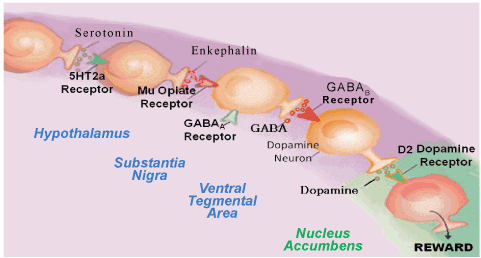
A host of medical and lifestyle issues can disturb the healthy flow of neurotransmitters, including chronic stress, alcohol, drug abuse, genetics, poor diet, digestive disturbances and mal-absorption, micronutrient deficiency and more. The result can be Reward Deficiency Syndrome (RDS), a term primarily used for hereditary chemical imbalances wherein the pleasure centers, which regulate feelings of well-being in the brain, fail to receive appropriate neural signals. As a result, the brain sends out urgent messages of craving. Doctor Dalal Akoury MD, President, and founder of the AWAREmed health and wellness resource center reiterates that, in the brains of addicts, various neurotransmissions are affected, depending upon the drug or drugs that have been used. As a result addicts experience difficulty concentrating and have mood swings, as well as having other physical symptoms.

Collectively, these symptoms are called cravings and withdrawals. Craving and withdrawal symptoms are a result of a neurochemical imbalance in the brain. If these imbalances are not addressed, life can be miserable to drug users and that is why doctor Akoury created this health facility with a primary objective of transforming each individual’s life through increasing awareness about health and wellness and by empowering individuals to find their own inner healing power. Besides that it will also interest you to note that, doctor Akoury’s practice focus on personalized medicine through healthy lifestyle choices that deal with primary prevention and underlying causes instead of patching up symptoms. This should motivate you to schedule an appointment with her now by calling her on telephone number 843 213 1480 for the commencement of your recovery process. And as you consider that, let’s look at some of the reward deficiency syndromes;

  • Neurotransmitters are chemicals in the brain that help to control states of consciousness, including moods.
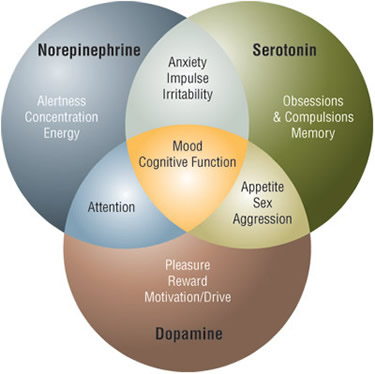
  • Serotonin and GABA down-regulate electrical activity in the brain, thereby contributing to calm, peacefulness, or less anxiety.
  • Adrenaline and noradrenaline up-regulate electrical activity thereby promoting excitement, motivation, or, reducing depression and apathy.
  • Dopamine is the “feel good” brain chemical. It is the dance of these electro-chemicals that produce emotional balance and feelings of well-being.

Reward deficiency syndrome and brain disease: When the neurochemicals are impaired

When the proper flow, or cascade, of these neurochemicals is impaired, or, the brain’s receptors are blocked, then a variety of problems can develop, including:

  • Mood instability
  • Irritability
  • Agitation
  • Hypersensitivity
  • Anxiety
  • Depression
  • Apathy
  • Impaired concentration
  • Trouble focusing
  • Despair

Finally, it is the Reward Deficiency Syndrome that causes the compulsive use of alcohol and drugs that help to feel good, at least temporarily. In addition to alcohol, people use nicotine, other stimulants, illicit drugs, junk foods, sugars, or thrill-seeking behaviors such as gambling, sex, and Internet porn. Unfortunately, this only provides temporary relief while bringing with it the possibility of more long-term problems. For lasting solution to addiction, only experts on the same line will liberate you from this problem. Doctor Dalal Akoury is an expert you can rely on for whatever addiction you are going through.

Reward deficiency syndrome and brain disease: Rebuilding Neurotransmitter

http://www.integrativeaddictionconference.com/wp-admin


Facebooktwitterpinterestlinkedin
Dopamine Rush

Neurochemical foundation of addiction

Neurochemical foundation

Neurochemical foundation of addiction treatment solutions begins with diagnosis and tests for accuracy in treatment delivery

Neurochemical foundation of addiction: The exhausted GABA

In order to understand the neurochemical foundation of addiction, it is important that we first understand how GABA operates. And to do so, we are going to speaking to doctor Dalal Akoury MD, President, and founder of the AWAREmed health and wellness resource center. And her submission she brakes the understanding as follows.

  • The neurons
  • The central nervous system (CNS)
  • Inhibitory neurotransmitters
  • Excitatory neurotransmitters

Having discussed the first two previously, we are going to progress with the remaining as follows:

Neurochemical foundation of addiction: Inhibitory Neurotransmitters

  • Some neurotransmitters act like a brake on a car.
  • They inhibit or slow down the actions of the neurons.
  • These are called inhibitory neurotransmitters.
  • Other neurotransmitters act like an accelerator.
  • They increase the speed of the actions of the neurons. These are called excitatory neurotransmitters.
  • GABA is the major inhibitory neurotransmitter in the brain.

Neurochemical foundation of addiction: Excitatory Neurotransmitters

  • Excitatory neurotransmitters are vital to:
    • Help us stay alert
    • Maintain our normal memory functions
    • Maintain our co-ordination
    • Maintain normal emotional responses
    • Maintain our heart rate
    • Maintain our blood pressure
  • Glutamate (a common amino acid) is the major excitatory neurotransmitter in the brain.

Which neurotransmitters are released?

  • If there is something that creates:
    • Anxiety
    • A feeling of panic
    • Other stress
  • Excitatory neurotransmitters are released and a person can feel:
    • Restlessness
    • Higher than normal irritability
    • Rapid heartbeats
    • High blood pressure
    • Insomnia
    • Even seizures.

The role of GABA in the brain

  • Glutamate speeds things up and when they are going too fast, GABA slows them back down.
  • If there is a problem with the GABA in our brains, the neurons fire more and more, increasing the speed of the processes in the brain?

Neurochemical foundation of addiction: How GABA works

When GABA binds to a nerve cell receptor, it opens the nerve cell so that chloride ions present in the brain are allowed to move into the nerve cell to slow the activity of the cell, and the person normally experiences a calming feeling. For example, if our brain produces more excitatory neurotransmitters like norepinephrine or epinephrine (adrenaline) than normal, we can become anxious or have more stress than normal. And when the brain is working normally, it will produce more GABA thereby slowing down the actions in the brain and thus have a calming and relaxing effect on us.

Finally, this article will go a long way in helping you do the right thing with your life. In doing so certain professional decisions will have to be made and to do this, seeking for the expert opinion will be necessary. And that is where doctor Dalal Akoury and her team of experts come in. the lever of professionalism at this facility (AWAREmed health center) speaks for itself since doctor Akoury’s practice focuses on personalized medicine through healthy lifestyle choices that deal with primary prevention and underlying causes instead of patching up symptoms. This is what you need and calling her on telephone number 843 213 1480 should be your starting point for the total life transformation.

Neurochemical foundation of addiction: The exhausted GABA

http://www.awaremednetwork.com/


Facebooktwitterpinterestlinkedin
Cigarette

Frustrating nicotine addiction for productivity

Frustrating nicotine addiction

Frustrating nicotine addiction for productivity is a perfect way of eliminating all the poisonous effects attached

Frustrating nicotine addiction for productivity: Smokeless tobacco

The wise said “where there is smoke there is fire” this is a common phrase in our society today and will remain so in the decades to come. For sure even when you take the face meaning of the phrase it is true that we may not see smoke in the absent of fire. For the purpose of this article, we are going to focus on frustrating nicotine addiction and for that reason, we’ll take smoke to mean the drugs and fire to be the nicotine. And speaking to the experts at the AWAREmed health and wellness resource center lead by doctor Dalal Akoury MD, it is regrettable that people who smoke do so for their own convenience despite knowledge of the negative effects associated with smoking. Because of consistent use of drugs even with the knowledge of dangers associated, drug addiction is also known as drug dependency and from this, it graduates to tolerance where the victims use more of the drug to experience the same effect says doctor Akoury. Now the next point would be responding to the question ‘what is the cause of addiction?”

Frustrating nicotine addiction for productivity: What causes nicotine addiction?

Nicotine is an addictive drug meaning that it causes changes in the brain prompting users to seek for more and more of the drug and this will eventually come with some unpleasant withdrawal symptoms. The combination of good feelings caused by the presence of an addictive drug and the bad feelings when the drug is not present make breaking any addiction very difficult. The addiction to nicotine has historically been one of the most difficult to break. The 1988 Surgeon general’s report, “Nicotine Addiction,” concluded that:

  • Cigarettes and other forms of tobacco are addicting.
  • Nicotine is the drug that causes addiction.
  • Pharmacological and behavioral characteristics that determine tobacco addiction are similar to those that determine addiction to drugs such as heroin and cocaine.

Therefore, when a person smokes a cigarette, the body responds immediately to the chemical nicotine in the smoke thereby causing a short-term increase in blood pressure, heart rate, and the flow of blood from the heart. It also causes the arteries to narrow. Carbon monoxide reduces the amount of oxygen the blood can carry. This, combined with the effects produced by nicotine, creates an imbalance in the demand for oxygen by the cells and the amount of oxygen the blood is able to supply. Smoking further increases the amount of fatty acids, glucose, and various hormones in the blood.

Nicotine in cigarettes increase the risk of heart attack

There are several ways that cigarette smoking may increase the risk of developing hardening of the arteries and heart attacks. First, carbon monoxide may damage the inner walls of the arteries that encourage the buildup of fat on these walls. Over time, this causes the vessels to narrow and harden. Nicotine may also contribute to this process. Smoking also causes several changes in the blood which include:

  • Increased adhesiveness and clustering of platelets in the blood
  • Shortened platelet survival
  • Faster clotting time
  • Increased thickness of the blood

All these effects can lead to a heart attack to anyone using such drugs which are why frustrating nicotine addiction becomes very essential. Therefore if you want to have a healthy life away from nicotine, schedule an appointment with doctor Akoury today for the commencement of your recovery process.

Frustrating nicotine addiction for productivity: Smokeless tobacco

http://www.integrativeaddictionconference.com/wp-admin

Facebooktwitterpinterestlinkedin
alcoholism

Understanding NAD (Nicotinamide Adenine Dinucleotide) role

Understanding NAD

Understanding NAD (Nicotinamide Adenine Dinucleotide) roles requires greater degree of professionalism

Understanding NAD (Nicotinamide Adenine Dinucleotide) roles: Cytochrome P450 2E1 (CYP2E1)

In light social drinkers nearly all the alcohol consumed is taken care of by alcohol dehydrogenase. However, the enzyme Cytochrome P450 2E1 (abbreviated CYP2E1) becomes quite active in metabolizing alcohol in chronic heavy drinkers. CYP2E1 does its work in the liver. The hydrogen released by this reaction is bound to oxygen and to NADPH to form water and NADP+. This reaction takes energy rather than producing it. CYP2E1 does its work in the microsomes of the cell. This is sometimes referred to as MEOS (Microsomal Ethanol Oxidizing System). CYP2E1 is a member of the Cytochrome P450 enzyme family as a better way of understanding NAD says doctor Dalal Akoury MD, President, and founder of AWAREmed health and wellness resource center. And now let’s turn to the last type of enzyme as stated previously.

Understanding NAD (Nicotinamide Adenine Dinucleotide) roles: Catalase

Catalase is found in tiny organs inside of cells called peroxisomes. Catalase is found all over the human body. When catalase turns alcohol into acetaldehyde the hydrogen which is released is bound to hydrogen peroxide molecules which then become water. Although catalase is active everywhere in the body, catalase is of particular interest to researchers because it metabolizes alcohol in the brain. The acetaldehyde released into the brain by the metabolism of alcohol by catalase has the potential to combine with neurotransmitters to form new compounds known as THIQs (tetrahydroisoquinolines, also sometimes called TIQs). Some researchers believe that THIQs are the cause of alcohol addiction and that the presence of THIQs distinguishes addicted drinkers from social drinkers. Other researchers strongly dispute the validity of the THIQ hypothesis of alcohol addiction. The actual role of THIQs remains controversial and calls for further research.

How Acetaldehyde Dehydrogenase Works

Acetaldehyde dehydrogenase does its work in the mitochondria of cells and removes a hydrogen atom from acetaldehyde to produce an acetic acid radical. This hydrogen atom combines with NAD+ to form NADH. There are several varieties of aldehyde dehydrogenase found in the human body. The one which normally breaks down acetaldehyde is called ALDH2. There is another variety aldehyde dehydrogenase found in the human body which is called ALDH2*2. ALDH2*2 is only about 8% as efficient as ALDH2 in metabolizing acetaldehyde. Some East Asian people have ALDH2*2 instead of ALDH2 in their bodies. These individuals find the effect of alcohol to be very unpleasant and that is going to form part of our discussion in the next article which I am persuaded you don’t want to miss.

Finally, doctor Akoury reiterates that the aldehyde dehydrogenase enzymes are found in many tissues of the body, but are at the highest concentration in the liver further explaining why alcohol addiction can be very dangerous to your health. And having known that, it will interest you to note that, the formation of AWAREmed health center was not just for the purpose of creation awareness about the effects of substance abuse, but also for finding the ultimate solution. And that is why away from creating awareness, doctor Akoury’s practices also focuses on the personalized medicine through healthy lifestyle choices that deal with primary prevention and underlying causes instead of patching up symptoms making her your best choice.

Understanding NAD (Nicotinamide Adenine Dinucleotide) roles: Cytochrome P450 2E1 (CYP2E1)

http://regenerativepotential.com/wp-admin

Facebooktwitterpinterestlinkedin