Tag Archives: Fighting substance abuse

Undersatnding addiction objectively

Seeking alcoholism treatment in good time

Seeking alcoholism treatment in good time: Getting the best out of addiction treatment

Seeking alcoholism treatment

Seeking alcoholism treatment in good time and knowing the right professionals to seek alcoholism and other drug addiction treatment from is very important in the overall recovery process.

We are taking a bit of our time in addressing the complications relating to drug addiction and more so when it comes to alcoholism because alcohol addiction is the leading substance of abuse currently. It is because of this background that we want to focus this discussion in knowing and seeking alcoholism treatment in good time so that a lasting solution can be attained. To do this effectively, we are going to be speaking to the professionals at AWAREmed Health and Wellness Resource Center the home of addiction solutions founded by doctor Dalal Akoury who is also the MD and President of the facility. According to the experts at this facility, the primary goal of alcohol addiction treatment is to deliver a lifelong commitment to abstinence from alcohol misuse. This is what we do professionally to our best and we believe that with good health, a strong support system and motivation, complete recovery is absolutely possible. Therefore if you or anyone you know is struggling with alcoholism, we want to bring to you the message of hope that this condition is treatable and we will be more than willing to help if only you can schedule for an appointment with us today by calling doctor Dalal Akoury on telephone number 843 213 1480. We want to assure you of our commitment in dealing with your situation in serious confidence and help you regain your health back to where it should be.

One of the primary problems with alcoholism is that it can often go undiagnosed despite being the most abused substance the world over. Nevertheless doctor Akoury reiterates that while there is no known cause of alcohol abuse or alcoholism, it is important to note that the quantity you drink can influence your chances of becoming dependent. The good news is that we now have a variety of brief and easy to use screening methods primarily designed to diagnose the problem of drinking and alcoholism and can be self-administered by a patient at the comfort of their homes. These are some of the efforts being made to help in containing the problem but all the same it is still important to acknowledge that typical treatment of alcoholism and even other substances can only begin when the alcoholic or the addict accepts the existence of the problem and is motivated to stop drinking of the habit. Up on acceptance, our team of experts will take you through the treatment process which often takes place in three levels including:

These are very fundamental and each of them is providing an integral step in the process of successfully giving up alcohol which is our desired objective for you. We know that acknowledgement can be very difficult to many patients, but remember even just by considering visiting an expert is in itself a progress. So don’t be worried just schedule for that appointment and we will help you all the way to your recovery from this problem.

Seeking alcoholism treatment in good time: The medical importance of alcohol addiction treatment

One thing that is important to note is that drinking too much in whichever way, whether binge drinking or chronic, can actually complicate your health negatively. Remember that alcohol is essentially poisonous meaning that using it repeatedly will affect every major organ in the body. Besides that it also increases the risk of developing disabling long-term conditions like diabetes, obesity, liver disease, heart disease, dementia and some forms of cancer.

Alcohol abuse is not only damaging to the body and brain, it also traumatize psychological stability causing depression, and is one of the leading risk factors for suicide. Alcohol abuse is the principal lifestyle-related cause of disease and death, motor vehicle fatalities and injury. Despite the profound effect alcohol abuse has on the individual and society, the most dangerous consequence is chemical dependence. Seeking medical treatment for alcoholism is absolutely necessary because once physically addicted to alcohol; there is risk of life-threatening side effects such as seizures, delirium, high blood pressure, sudden fever and debilitating dehydration.

Seeking alcoholism treatment in good time: Availability of treatment for alcoholism globally

The abuse of alcohol worldwide is a problem which compromises both individual and social development, resulting into millions of deaths each year and causing over 200 different diseases and injuries. Looking at the available statistics, you will be very shocked to note that in most states people often drink more than 50 per cent above the global average with Canada and North America leading with people in Europe and parts of Sub-Saharan Africa following suite among the world’s heaviest consumers of alcohol on average. It is however regrettable to note that from the research findings the amount and patterns of alcohol consumption by country suggests alcohol use is the third leading global cause of disease and death after high blood pressure and tobacco smoking, among 67 other risk factors overall.

These statistics illuminate how the risk of alcoholism is not limited to a particular ethnic community, socio-economic status or region of living. While regulations and laws about alcohol consumption vary geographically with trends and culture, at least 34 countries have adopted formal policies to reduce the harmful use of alcohol. Alcoholism treatment is available in medical centers globally where you can find an individualized care and treatment program that best suits you.

Finally we must all appreciate that treatment for alcoholism does not necessarily prescribe an easy cure for chemical dependency, instead it gives the individual patients all the tools they need to rebuild life based on promoting sobriety daily. Since addiction and alcoholism effect almost every area of an individual’s life, the changes which will be made may sometimes be slow at the initial stages, but the benefits is that they will be all be encompassing. Therefore we must appreciate that after completing the detox process in rehab facility, the maintenance of sobriety will be essentially connected to the readiness, openness and honesty put into living one’s life by a new set of principles and values. What is most important to remember is that treatment and long-term sobriety are about discovering how to accept help, and manage life’s challenges without needing to escape or find a quick fix. This new way of living will provide new meaning and direction and those with rich participation in recovery will achieve freedom and serenity.

Seeking alcoholism treatment in good time: Getting the best out of addiction treatment


Facebooktwitterpinterestlinkedin
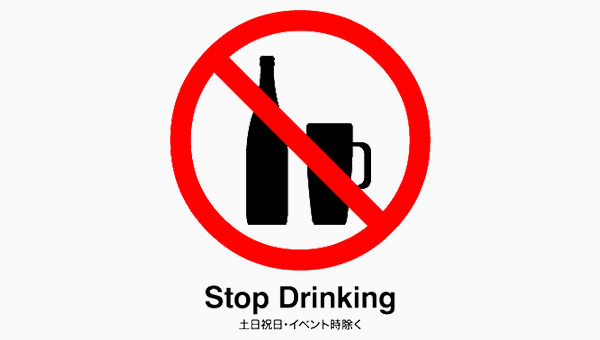
stop drinking

Confronting friends struggling with drug addiction

Confronting friends struggling with drug addiction: The best ways of approach

Confronting friends

Confronting friends struggling with drug addiction can be quite challenging. However, it is the right thing to do and very necessary more so in helping solve the problem

The best thing you can do to your friend who is struggling with an addiction is to give moral support and advice on the need to seeking professional treatment from experienced qualified addiction experts. This may seems easy by word of mouth but in reality there are very many obstacles that can make you keep distance even if there is the willingness to help. Fear is always the biggest obstacle and many at times confronting friends who are struggling with addiction becomes difficult thereby causing our loved ones to suffer because we are afraid of facing them with their addictive habits and lifestyle. The purpose of this article is to help you in understanding certain tips you can apply in confronting a friend with a drug addiction problem. Doctor Dalal Akoury MD and President of AWAREmed Health and Wellness Resource Center is a veteran addiction expert of several decades and she is sharing with us in this article that if you have a friend who may need drug intervention help, you must never choose to keep quite with that. Remember that substance abuse can be life threatening if not addressed in good time. Therefore we want to share with you some of the valuable tips that you can use to have a breakthrough in helping your friend consent to treatment without feeling embarrassed or intimidated. Before confronting friends struggling with drug addiction, doctor Akoury says that there are things you can do to prepare for your talk with the friend as well as specific practices to carry out when you talk to them. Remember that you have one very powerful tool (friendship) with you to break the silence, and because you are the friend the first step to recovery is getting your friend to the position of admitting that they have a problem, and getting them into a drug treatment program. This is always the greatest challenge because many addicts do not want to acknowledge that they have a problem which needs to be fixed. Denial is very rampant with most addicts and any breakthrough on this will be a great achievement. Here are some basic drug addiction intervention guidelines that have been proven to be effective with other patients in the past.

Confronting friends struggling with drug addiction: Intervention tips for before you talk with the friend

Like we have said before that, confronting a friend with a drug addiction problem is such an uphill task and so when considering this journey you must be very well prepared for it. For your objective not to fail it is important to be prepared for your encounter with the friend. Remember that you want to help and therefore you must be well informed of various consequences of addiction, your approach must not be intimidating or provocative, you are on a mission and you must show them that you are supportive and committed to helping. Achieving this will not be anyone’s cup of tea and be ready for rejection and formulate ways of handling that when it comes so that you are not demoralized in the process. These tips may not be conclusive, but they will help you make some progress in winning your friends mind into acknowledgement of the problem they are going through and enrolling into a treatment program.

  • Because of the mission ahead of you, it is important that you learn more about drug abuse to have a better understanding of what your friend is dealing with. This way you will be more competent to respond to them if they ask you any challenging question.
  • Before you get to your friend, it is important that you put down in writing a list of all the issues you believe have been a result of the person’s drug use. There are very may indicator you can think of including noting down systematically the times the person missed an appointment, relationship issues, unusual behavior you’ve noticed such as losing interest in hobbies, no longer paying attention to hygiene or dressing or antisocial or argumentative behavior. Take note that these are your observations and so you must be able to display to your friend both the present and the past. What they used to do then which they are not doing now or they are doing but in a funny way.
  • The place of your first meeting is very important in this mission and therefore you must plan in advance to meet the person in a location that will be private, neutral and free from distractions. It should be a place where you believe you’ll have their attention. Always avoid places that will trigger them into craving for the drug.
  • Another very fundamental factor of consideration is the meeting time. It is therefore necessary that your choice of time is accommodative more so to your friend. Remember that the time should also be when the person is not under the influence of drugs if at all possible. They might be more open to listening to you when they are sober than when under the influence of their drugs of choice.
  • Being smart is an asset in this mission. In other words you should be armed with possible solutions to offer when that point comes up. For this reason you should be informed about steps the person can take to get help. We appreciate that this can be challenging but for you to succeed you may want to contact your local community health office for more information before embarking on the mission.

Confronting friends struggling with drug addiction: Confronting a friend about drug addiction

These intervention tips will help you be most effective when talking to the friend about your concerns.

  • Let the friend know that your friendship is important and that they mean a lot to you, that your concern grows out of the fact you care about them.
  • Be straightforward. Share what you’ve seen and why you think it’s a problem. Be rational rather than emotional. The more specific you can be the better.
  • Be supportive rather than condemning or condescending.
  • Point out, again, without condemnation, the differences you see in the person when they are sober and when they are under the influence.
  • Don’t argue with the person. Just state your facts and perceptions and let them sink in. Repeat them if necessary, but not in an argumentative tone.
  • Make a distinction between the person and their behavior. Say, “you’re a great person, but when you’re on drugs, you don’t seem to care about your life, your goals or your friends.”
  • Encourage the person to seek help, and encourage them that effective treatment is readily available to those who want to overcome drug addiction.
  • Share with them the pertinent information about where to seek this help.
  • Assure them that you’ll be supportive of them if they seek help. Let them know you’ll stand beside them.

Finally use this drug intervention help to tell your friend what you see. He or she probably knows that their drug use is out of control, and hearing it from someone who shows care and concern as well as offers help. The encounter could be a turning point in their life. You may not be able to force someone into rehab, but helping them discover the truth about themselves may help them do it on their own by scheduling for an appointment with doctor Dalal Akoury for timely professional treatment.

Confronting friends struggling with drug addiction: The best ways of approach


Facebooktwitterpinterestlinkedin
alcohol and cancer risk

Cognitive behavioral therapy for addiction treatment

Cognitive behavioral therapy for addiction treatment: Shaping the mind to deliver addiction solutions

Cognitive behavioral therapy for addiction treatment

The application of Cognitive behavioral therapy for addiction treatment solutions is one of the painless treatment approach that is suitable for everyone

Somebody once said that what you see in the outside of any person is the manifestation of what is taking place in their mind. It is also true that out of the mind we speak and take actions on our daily activities. This is also applicable with the issues relating to substance abuse and misuse of alcohol. It therefore means that if we want to be in total control of our actions, the most important thing to do is to have sobriety and exercise good control of our minds. Many people normally get into drugs because of the influence they have from their friends and pressure of wanting to belong and not to be left out in the process. The drug barons have actually succeeded in luring people both the young and the old into drugs because they have understood that when the mind is destabilized, then they will be in business because you will certainly buy to quench your thirst for the drug and to temporarily escape withdrawal symptoms for a while. Over the past we have dealt with several modalities of offering addiction solution to all people and Doctor Dalal Akoury has been of great help in making us understand the root causes of this problem and also the solution to the same. In view of that, we want to focus on the topic “cognitive behavioral therapy for addiction treatment.” We owe it to ourselves and to our children’s children that we must have a healthy environment to live in. the intoxication of our surrounding is what we must all address and cognitive behavioral therapy (CBT) is one of the avenues of addressing it.

Cognitive behavioral therapy for addiction treatment: When cognitive behavioral therapy becomes necessary

According to the experts at AWAREmed Health and Wellness Resource Center over the past years there has been increasing interest in cognitive behavioral therapy (CBT) as a means to help clients escape from the scourge of addiction. CBT is actually a kind of talking therapy where the emphasis is made on empowering the individual patient to take charge of their own thoughts and feelings. In many instances the majority of the problems the individual will often experience will be due to faulty thinking or belief about themselves or others. Like for example, it is possible for the individual give up on life and develops the feeling that they can never be loved by someone. And such negative thought can be very dangerous because such thinking can lead people into addiction. This is what the application of cognitive behavioral therapy needs to address. And by examining thoughts and feelings more closely the client, and with the help of the professional therapist from AWAREmed Health and Wellness Resource Center, one is able understand them a lot better. Remember that one of the advantages of CBT is that it can lead to breakthroughs in a relatively short period of time – although this is not always the case. During the treatment the client is encouraged to examine those thoughts that are leading them to engage in substance abuse. Once they see that their flawed thinking has been the source of much of their problems they will find it a lot easier to break away from addiction.

Doctor Akoury is registering that even though cognitive behavioral therapy is all about mind set, it may not be as easy as it is pronounced. Many addicts are living in great denial and so even applying what appears to be simple and straight forward may be a great challenge. It is because of such challenges that doctor Dalal Akoury founded this facility (AWAREmed Health and Wellness Resource Center) primarily to transform each individual’s life through increasing awareness that will bring a total mindset change about health and wellness and by empowering individuals to find their own inner healing power. Besides that it will also interest you to note that in her several decades of impacting positively in people’s lives, Dr. Akoury’s practice are of the highest standard of profession and focuses on personalized medicine through healthy lifestyle choices that deal with primary prevention and underlying causes instead of patching up symptoms. This is what you and your loved ones need if you are struggling with any kind of addiction. If this description suits your situation, then you need not to die silently. You can therefore call on doctor Akoury today on telephone number 843 213 1480 to schedule for an appointment of your life time and by the time she will be done with you, you will be a completely different and changed person with great life a head of you for an absolute fulfillment and comfort.

Cognitive behavioral therapy for addiction treatment: Pros and cons of behavior therapy as an addiction treatment

And just like any other thing around you, there will be some merits and demerits. Therefore even though cognitive behavioral therapy can be highly effective, it is probably not going to work for everyone. That is to say that some people may lack the insight to be able to benefit from CBT for various reasons. Nonetheless some of techniques like self-monitoring will require a high degree of self-honesty which can be a serious problem to very many individuals struggle with this problem of addiction. Besides that there is also the worry that aversion therapy may prove harmful, and in particular, overt techniques that produce vomiting or involve electrical shocks. Anti-abuse can lead to death if the individual has consumed too much alcohol. And finally doctor Akoury reiterates that there is no doubt that behavior therapies can help the individual beat their addiction. This is why such techniques have been widely adapted in rehabs and other treatment programs. Remember that CBT receives a lot of praise for its ability to get the individual to take charge of their own life. Such empowerment can not only help them escape addiction, but to also build a successful life in recovery in the long run.

Cognitive behavioral therapy for addiction treatment: Shaping the mind to deliver addiction solutions

Facebooktwitterpinterestlinkedin

Parents role in handling their addicted teens

Parents role in handling their addicted teens: Management of teens substance abuse professionally

Parents role in handling their addicted teens

Parents role in handling their addicted teens is very important as it will contribute immensely in the reduction of the damages caused by drug use by teens and collage going youths

While we were handling the teens substances abuse professionally in our previous posting, we noted that there four fundamental elements that parents need to be well equipped with if this war of drug addiction is to be warn in the lives of our teens and children. We want to progress from where we left and look at the remaining three points to consider even as we explore the parents role in handling their addicted teens. Doctor Dalal Akoury is very much concern particularly with young people getting into drugs. She says that getting into drugs at these early stages of life is very dangerous and complicates treatment in the long run. Professionally it is very difficult to rehabilitate one who started using drugs in their youthful ages. Nonetheless she is quick also to put the record straight that despite the above concern, it does not necessarily justify the fact that it will be well if one start using drugs and alcohol in their mature ages. Drug addiction is a chronic problem that everyone must run away from by all means and this must be done not tomorrow but now says doctor Dalal Akoury (MD) a veteran addiction expert and founder of AWAREmed Health and Wellness Resource Center where real time solutions of substance abuse is professionally realized. Now after getting the necessary education and you have laid good foundation in terms of preparation in helping your teen get properly rehabilitated from their drug addiction, you can then move to adopting the following procedures.

Parents role in handling their addicted teens: Development of a strategy and work plan

Doctor Akoury says that the moment a parent has established that his or her child is into alcohol or drug abuse the most immediate thing to do is to get information about drug addiction by way of being educated on the subject and this must be done by addiction professionals and experts from AWAREmed Health and Wellness Resource Center can be of great help in this respect. The moment that is done, it’s now time to create an actionable plan. In other words, as a parents you need to come up with workable plan on how you are going to professionally confront your teen with the news of your discovery of his/her substance abuse habits, this will most likely involves you pre-emptying some of the anticipated possible responses and reactions and deciding how best to address them even before they come. When the confrontation occurs, teens will likely deny the accusations initially due to the fear of reproach and punishment; however, when reaching the point of finally admitting to the problem he or she will likely make excuses for the behavior so as to be held in the least possible amount of accountability. The following are some of the common excuses that are likely to be given by teens abusing substances; stress from parents’ marital discord, the influence of peers, and feeling depressed or anxious. In other words they will try to justify their substance abuse behavior as being their reaction to external stimuli and, therefore, not really their fault.

Besides that the other part of the plan should include deciding upon the consequences. If the teen has abused alcohol and drugs in the past and the present instance is a repeat offense, there must be some sort of immediate consequence as well as consequences for the future if the behavior continues.

Parents role in handling their addicted teens: Choose the right environment and confront the teen

It’s important for the confrontation to occur in an environment that offers safety from distraction and intervention from third parties. Moreover, it should be a place where the teen would feel comfortable and safe, which would likely be the family’s home in a communal living area. Privacy is also important so siblings and other individuals should not be present during the exchange. During the confrontation, parents should refrain from being too aggressive and accusatory as it will make the teen less likely to participate in the conversation. Compassion and understanding are essential as it will make the teen feel as though the parents are trying to empathize and see the situation from the teen’s point of view. Parents should remember that the most central goal of the confrontation is to understand the factors motivating the teen’s substance abuse behavior whether due to his or her social group, feelings of depression and anxiety, or some other inner turmoil so that those factors can be addressed in order to prevent additional substance abuse.

It is important that during the discussion, parents should explain to the teen the dangers of substance abuse, including the health risks and potential sacrifices made in the course of active addiction. Addicts often lose their jobs, financial stability, homes, relationships, and many other prospects, leaving them with only their expensive substance abuse habits. Additionally, parents of teen substance abusers should outline the consequences for substance abuse progressively. In dealing with teens it is worth noting that a teen’s substance abuse problem can be an emotional one and trying time for a family; however, if handled correctly the parents and teen could gain a better understanding of other perspective of substance abuse and result in the family’s becoming a more united unit.

Parents role in handling their addicted teens: Explore substance abuse treatment options today

Finally if you or someone you love is suffering from a substance abuse disorder and would benefit from addiction treatment, the experts from AWAREmed Health and Wellness Resource Center under the able leadership of doctor Dalal Akoury can be of great help. At this facility, we have a team of recovery specialists available in every discipline offering professional consultations and assessments in order to match those suffering from chemical dependency to the therapies that will allow them to regain their sobriety and health. Therefore if you are considering the option of exploring substance abuse treatment, then this is the place to be, all you have to do is to schedule for an appointment with doctor Akoury and your situations will be settled in the most professional way that will be more fulfilling leaving you to enjoy the life ahead of you with great comfort and satisfaction.

Parents role in handling their addicted teens: Management of teens substance abuse professionally


Facebooktwitterpinterestlinkedin

Exploring nutritional therapy for substance abuse eradication

Exploring nutritional therapy for substance abuse eradication: Being objective in dealing with addiction

Preceptorship Addiction Treatment – Effective Treatment Support

Exploring nutritional therapy for substance abuse eradication

Because complications relating to drugs addiction are not going to go away anytime soon going by the various statistics gathered from research documents, we need to up our sleeves into bringing this ghost of addiction to manageable levels. That would therefore means that no stone must not be left unturned and everyone must be brought on board for the operation to be successful. For that reason, AWAREmed Health and Wellness Resource Center under the able leadership of doctor Dalal Akoury who is a veteran addiction expert of several decades is going to share with us in depth about exploring nutritional therapy for substance abuse eradication from our societies. This is very important not just to the direct victims of substance abuse but even to their loved ones who are equally affected even if it is indirectly. We are therefore going to us this article to conclude on the two elements we did not handle while discussing on the topic “medical nutrition therapy for substance abuse” in our previous article. The two elements we want to address include:

  • Weight management and eating disorders and
  • Pharmacotherapy

Exploring nutritional therapy for substance abuse eradication: Weight Management and Eating Disorders

According to the experts at AWAREmed Health and Wellness Resource Center, the problems that are associated with weight management are common nutritional concern related to substance abuse. In the same discipline detoxification programs are commonly seen to be leading to weight gain, as addicts being taken through the process often turn to food instead of their drugs of choice. Besides that biochemical changes also result in increased appetite and a preference for highly palatable foods, and confusion in hunger/fullness cues arise. However, for some, weight gain is important due to significant protein-energy malnutrition and low BMI as a result of substance use. Doctor Akoury is raising concern that increased consumption of lots of calories and weight if not managed properly can lead to other devastating health complications including obesity, diabetes, hypertension and cardiovascular disease, therefore it is very important that professionals in this discipline should monitor and counsel patients on healthful eating and weight management and that is what doctor Akoury and her team of experts at AWAREmed Health and Wellness Resource Center are doing relentlessly in giving their contribution towards fighting the scourge of addiction from our systems.

While in treatment, most patients reduce their levels of exercise either due to lack of time, the program structure, or lack of motivation. Increased abnormal liver tests are common in re-feeding among hospitalized drug addicts, which is theorized to be caused by a lack of exercise and increase in weight. According to a study conducted by the Journal of the American Dietetic Association, it was established that the daily weight change had a significant positive correlation with changes in serum alanine transaminase or aspartate aminotransferase concentrations from admission to discharge. Experts can therefore help in monitoring weight gain and laboratory results primarily to identify patient goals for achieving or maintaining a healthy weight. They can also work with professionals including the families and relatives of the victims to develop exercise programs during and after treatment that can help to level patients’ liver enzymes and manage their weight.

Doctor Akoury is of the opinion that with the high prevalence of eating disorders in the substance abuse population, care must be taken in making recommendations for weight management to ensure they aren’t too restrictive and weight gain or loss is monitored and steady. It is a point of great concern that up to 72% of women who are below 30 years of age and are struggling with alcoholism have eating disorder problems and besides that, other substances such as cocaine are associated with a higher prevalence of eating disorders, it is therefore very important that careful attention and precautions be taken when working with these populations.

Exploring nutritional therapy for substance abuse eradication: Pharmacotherapy

The next element of discussion is the pharmacotherapy which is a common component of addiction treatment. While exploring nutritional therapy for substance abuse eradication, it is important to note that these medications are intended to improve mood stability and recovery success and to assist with any medical or mental health problems resulting from or co-occurring with detoxification. When exploring this working with experts is very important because they can help in the management of any nutritional implications of these medications says doctor Dalal Akoury.

According to the experts at AWAREmed Health and Wellness Resource Center, medication-assisted treatment for substance abuse has been effective for alcohol and opioid dependence immensely. It’s important for dietitians to be familiar with these common medications, because the side effects may influence patients’ nutritional status. Alongside that, dietitians need to be cautious when recommending supplementation in this population due to addicts’ quick-fix mindset and already-taxed bodies. Taking cognizance that a damaged liver may not be able to correctly process certain supplements, and the supplements may ultimately have a negative impact on liver health. And that not with-standing nonetheless, and according to a study funded by the National Institutes of Health it was suggested that a common over-the-counter herbal supplement, N-acetylcysteine, can reduce the cravings of cocaine and heroin addicts and possibly alcoholics during withdrawal.

Finally Naltrexone (ReVia, Vivitrol, Depade), disulfiram (Antabuse), and acamprosate calcium (Campral) are used to treat alcoholism. Naltrexone, which also has been used with opiate and narcotic dependence, may cause anorexia, weight loss, nausea, and vomiting. Disulfiram may cause nausea and vomiting, and if patients ingest alcohol, they will become very ill. Therefore, care must be taken to ensure that all traces of alcohol are eliminated from patients’ diets, including any that may be used in recipes. Acamprosate calcium may cause an increase in appetite, increased weight, and taste changes. Dietitians should take note of these side effects and work with patients to identify ways to promote adequate nutritional intake. With all these worthy points about exploring nutritional therapy for substance abuse eradication, if you still have any area of concern that you need to be clarified, you can schedule for an appointment with doctor Dalal Akoury for a one on one professional touch today and you will never be the same again there-after.

Exploring nutritional therapy for substance abuse eradication: Being objective in dealing with addiction


Facebooktwitterpinterestlinkedin