Tag Archives: Addiction

Addiction Recovery

Shopping addiction treatment restore relationships

Shopping addiction treatment strengthens relationships: What you stand to gain by solving shopping addiction problem

Shopping addiction

Shopping addiction like any other addiction must be addressed medically and that way relationships will be strengthen

For a very long time it has not occurred to people how shopping addiction can impact negatively to our social lives. Many social activities are bound to suffer if this (shopping addiction) is not addressed. Whereas it may not have any direct health complication, the social injury it will inflict can be very devastating. Therefore anyone who is struggling with shopping addiction is likely to have serious social problems with the people around them in terms of their finances, relationships and your even mental health. To avoid this doctor Dalal Akoury MD, President and founder of AWAREmed Health and Wellness Resource Center, a health facility whose primary objective is to help people across the globe find life more enjoyable through effective and professional addiction treatment is registering that getting help is the best decision that one struggling with this can take to benefit wholesomely for the rest of the years to come.

I am aware that a number of people love visiting shopping malls within their borders and abroad because shopping has become like a hobby to them. However when this hobby goes to the extreme where one goes shopping even for the things they don’t need or have already bought then it translate into an addiction called compulsive buying disorder. At this point the addicts becomes so much into it that they literally find it too difficult if not impossible to prevent on their own. If this description suits your situation, then you need help because sooner or later this will cause real issues in your life including issues relating to financial, legal, or psychological problems. Unless these are addressed says doctor Akoury “you will continue struggling with them and because of this (your compulsion to shop), you should consider attending shopping addiction treatment immediately. The good news is that besides AWAREmed Health and Wellness Resource Center there are so many other treatment facilities and programs available for this sort of issue, and it can be much more beneficial than continuing to ignore the problem. With compulsive buying disorder treatment, you can end your addiction to shopping for good.

Shopping addiction treatment strengthens relationships: Do I need shopping addiction treatment?

Somebody once said that behavioral addiction is the silent killer people often ignore as they run to solving what is seen as chronic health complications like diabetes heart disease and the likes. But take a moment and look at the weight in this statement in relation to our discussion. We have already stated that many individuals like shopping and may take it in as a hobby and sometimes can even be obsessed with the whole thing. Yes shopping is not bad, but it is important to remember that when it reaches the point of obsessions, even though we may not understand them in others, it can make people happy, however, the addiction part of it will not. The compulsive action of shopping involved in this disorder makes a person buy things even if they do not want to or do not have the money and the consequences of such behavior can really cause social breakdown.

Shopping addiction treatment strengthens relationships: Signs and symptoms of compulsive shopping

Knowledge is power and therefore it is good that you’re informed of these signs of shopping addiction for you to take remedial action promptly. Therefore If you are wondering whether or not you may be addicted to shopping, look for these signs of compulsive shopping in your life and take timely action to salvage the situation before it is too late:

Are you thinking more than you want to about shopping? – This could happen in environments where shopping should not be thought of like when you are in class, at work, or otherwise engaged in another activity. If in such environments all that rings in your mind is shopping instead of concentrating on your current work you could be developing shopping addiction.

You prefer to shop alone to avoid embarrassment or distractionIf you are constantly buying more than you need or should buy, you may feel uncomfortable doing so with other individuals. Furthermore, if you feel that other people are always a distraction to your shopping, it may be more of an anxious activity for you than a fun one.

Your shopping time is prolonged that necessary – If this description suits you then you need to take action. Check your shopping trend does it cause you to miss other important appointments consistently? Do you always loose truck every time you are shopping, take note this could be a strong indicator of shopping addiction and you should consider treatment.

You buy things you don’t need or want or always buy more items than you planned – if you are that person who always quick to purchase new items even if you don’t need them this could be a sign of compulsion that shows that you are not in control of your shopping. And if you constantly buy more than you intended to buy to the point that it affects your monetary situation, this is another bad sign.

You hide what you buy to avoid conflicts at home – Also if you hide the debt that you are in because of your constant buying, this is another sign of addiction. Addicts can become very secretive and justify actions that they know are wrong in order to keep fueling their addiction.

Finally doctor Akoury concludes that anyone who is addicted to shopping may also experience “pre-purchase tension or anxiety” which diminishes immediately the thirst for shopping is quenched by taking time out to shop. The social implications that comes with shopping addiction is one that you do not want to find yourself in and therefore the sooner you take shopping addiction treatment seriously the better. You may want to schedule for an appointment with experts at AWAREmed Health and Wellness Resource Center under the able leadership of doctor Dalal Akoury for a more elaborate and professional treatment.

http://regenerativepotential.com/integrativeaddictionconference/

Facebooktwitterpinterestlinkedin
The-Gut-Brain-Skin-Microbiota Axis

Understanding GBSM: The Gut-Brain-Skin-Microbiota Axis

GBM Axis: Gut-Brain-Skin-Microbiota Axis – The Symphony of Survivorship vs Environment

The Gut-Brain-Skin-Microbiota Axis is just one of the fascinating (but often ignored) medical subjects that will be discussed at the upcoming Integrative Addiction Conference in Austin, Texas during August 2016.  Should you be interested in finding out more about the GBSM or GBM Axis and its relation to physical, mental and emotional disease and addiction, be sure to book your space by following our link – http://regenerativepotential.com/integrativeaddictionconference/

A small list of some of the subject matter that will be discussed by leading experts in their fields, include

  • How gut changes the brain
  • Why addiction treatment requires gut treatment
  • Restoring the gut heals addiction
  • Gut neurotransmitters – connection and addiction
  • Reset gut microbiota – reset sanity
  • Brain-gut addiction

When our intestines are in perfect balance – the GBSM or GBM Axis, results in a symphony of beautiful balance and health that ensures our survival.  But this symphony is deeply affected by our internal and external environments and how we react and relate to these on a moment-to-moment basis.  The key to health therefore lies in our bacterial environment – primarily that of our intestines.

The-Gut-Brain-Skin-Microbiota Axis

Microbiota is the word used to refer to a community of bacteria.  These communities encompass a myriad of bacteria and microscopic organisms in their various forms and capabilities, positive and negative that occupy every conceivable area within and around us.  From the depths of the frozen tundra and oceans, to our deserts, swamps and rain forests, these microorganisms also live within and on their human hosts. They are so prolific that more than a thousand different varieties have been found in a single human sample. Their proliferation bears testimony to their adaptive and often symbiotic nature with humans and recent studies of genome sequencing indicate that we share up to a third of our genes with other life forms and some 37% with these bacterial communities.

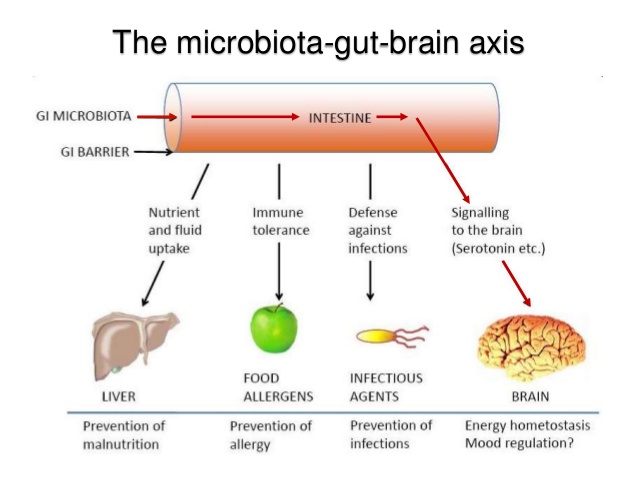
Many of these bacteria share our bodies on a mutually beneficial basis.  Pro- and prebiotics are an example of the “good” bacteria that occupy our gut space.  These living organisms promote our health by metabolizing complex lipids and polysaccharides for optimal nutritional absorption.  They protect our gut health by warding off harmful bacteria, neutralizing carcinogens, drugs, managing motility of our intestines and affecting our visceral perception (an internal understanding that operates independently of our consciousness level).  These endosymbionts are also successful in working with the guts “nervous system” to provide feedback to the central nervous system.  This feedback is crucial to maintaining balance within our system, including the development of our immunity.  Once it was recognized that microbiota in our intestines played such a significant role in our health that included a sophisticated signaling process, the idea of the Gut-Brain-Skin-Microbiota Axis – or GBSM Axis was born.

Our health and survival are reliant on these powerful, yet infinitesimal life forms as they affect both vegetative and cognitive functions of our central nervous systems (CNS).  The reverse is also true with the CNS affecting development and composition of these microbiota.  This symbiotic relationship is so powerful that any imbalance of power in this environment can lead to the development of metabolic, emotional and mental diseases.

The importance of this GBSM Axis is emphasized by the results of recent studies that show how these bacterial communities affect our immune systems, higher cognitive function and socialization and social structures at a psychological level in relation to sexual behavior, our choice of a partner and our levels of social perception and more.

The super highway feedback system between gut microbiota and the CNS involves the immune, endocrine and neural pathways, thus forming the MGB Axis.  When under extreme stress, our brains may influence the balance of gut bacteria through the hypothalamus-pituitary and adrenal glands – the HPA axis.  This axis manages cortisol levels that affect immune cells on a local basis and systemically in the gut.  The HPA axis regulates inflammatory responses to injuries from a neuronal perspective by producing catecholamine production.  This feedback system leads to balance – or homeostasis.  A disorder such as stress will therefore affect this balance and lead to allergic reactions, inflammatory disorders, disease and a predisposition to infection.  Cortisol can also change intestinal permeability and barrier functionality and contribute to the imbalance of “good” bacteria.  The reverse is also true where pre- and probiotics can change cytokine levels that may affect brain function.  The afferent branch of the vagus nerve and regulation of systemic tryptophan, the precursor to the serotonin transmitter, are also both strongly involved in carrying messages of gut microbiota to the brain.

 GBSM Axis

Studies conducted suggest that gut microbiota levels also have a strong effect on brain function in terms of anxiety, cognitive dysfunction, depression, emotions, motivation, memory formation, affective behaviors, decision making and emotional arousal.  This is supported by studies conducted on the insular cortex and related networks in the brain.

Our intestines are an extensive network of neurons that are often referred to as our second brain.  So intelligent is this system and so crucial is it to our health, but yet so often overlooked.  It is little wonder that more research is being directed to the GBM Axis as a source of a vast majority of diseases that are thought to be related to stress.  Our stress levels have a direct influence on the health of our gut environment that affect not only our physiological, but also our mental and emotional health and functions.  This enteric nervous system has over 100 million neurons in the nine meters of its length that it is often referred to as a second brain.  A “brain” that contains more neurons than either the spinal cord or the nervous system with 90% of the information transmitted by the vagus nerve involved in the relay of information from the gut to the brain – rather than the reverse.  It behooves us then to find out more about its functioning to ensure that this environment remains a symphony of health as opposed to an environment of deadly disease or addiction.

Facebooktwitterpinterestlinkedin
Obesity an addiction

Obesity addiction or Lifestyle is it a fact

Obesity an addiction or Lifestyle what is true medically: Why obesity is not what people think it is?

Obesity addiction

Obesity addiction or Lifestyle what is true medically? And why obesity is not what people think it is?

The gospel being spread across the globe about obesity and how it comes is misleading and intimidating to the victims. Many have insinuated that obesity is a lifestyle and not a health condition. This is not true and must be addressed professionally in good time because sincerely obesity addiction is a fact and not a lifestyle as many have been made to believe. If you want to understand clearly why obesity is an addiction, we want to encourage you to keep on the link and be enlightened by the regular postings on this and many other health related matters of concern. We understand the health complications that come with this condition and because of that and many other addictions related complications we are holding our second Annual Integrative Addiction Conference Workshops and this time our Conference Venue will be at Austin Texas: Doubletree by Hilton Austin. This is a very good forum for you and all health professionals across the globe. For further enquiries you can reach us on telephone number: 512-454-3737 Fax: 512-419-0102 at 6505 Interstate Highway-35 North Austin, TX 78752.

Now back to our discussion, the society has judged people very unfairly on this subject. Obese people have suffered stigma in the hands of those who needed to help them live a health and more comfortable life. They have been branded people who only care about over indulgent with food and who have total disregard for their health and appearance. This is a very cruel way of handling obese people. To correct this, experts across the globe including those from AWAREmed Health and Wellness Resource Center where doctor Dalal Akoury is the MD, President and founder of the same are working on people’s psychology and with the application of modern medication to help change the deeply rooted wrong mind set about being obese and what causes it. From the various research conducted, it has been established that obesity is quickly becoming an epidemic health problem in most states across the globe and the sooner this is addressed the better for our future generations.

Obesity addiction or Lifestyle what is true medically: The deadly variables

Interestingly, this problem is with us and many at times we are doing very little to bring it to manageable levels. Doctor Dalal Akoury having been in this profession for well over two decades now is pointing out certain variables that are so notorious in the facilitation of overweight and obesity. She says that due to the kind of life we live today the variables may include genetics, too much viewership of television, decreased exercise, print and electronic media advertisement focusing on junk food thereby encouraging consumption of food stuff rich in high fat and calories besides many other factors perceived to be contributing to the problem of obesity.

Besides the aforementioned variables above, the another factor of consideration is as a major cause of obesity is that it is possible that obesity may be an addiction just in the same way as heroin, alcohol, cigarette smoking, cocaine and other drugs. The only difference is that where as with other substances of abuse, you may learn progressively on how to stop using them (substances), it is not so with obesity because you actually need food to live and to be productive. And this is further complicated by the abundance of food literally every ware. It then becomes difficult for many to help themselves with this problem of obesity because while on the other hand food is needed for life, on the opposite side this same basic need is causing people to become obese.

In a recent study conducted by the American Psychological Association, it was established that in most cases overweight or heavy people are fond of marrying their equals in relation to weight further increasing the likelihood that any genes for weight will be passed on the next generation. We are still explaining why obesity addiction is a fact and not a lifestyle as it’s popularly believed. And because of this our children from their culture will be seeing us their parents as their role models. What that communicates is that the cycle of rising obese generation after generation is not likely to be broken if something is not done soon. Children learn majorly from observation, they will be keen in observing the behaviors and lifestyle of their parents and if they see poor eating habits, that is what they take in as the right thing to do.

Obesity addiction or Lifestyle what is true medically: Stress

Stress is another explanation as to why there is such an increase of overweight and obesity in the United States and most states across the globe. Research has established that when people are stressed up in whichever way, they are likely to seek solace on food. This practice increases the quantity of food consumed by individuals and going by the stressful life situations we constantly find ourselves in, we will be eating from time to time and the consequence of that is more weight leading to being obese. Lack of exercise is another factor of consideration when it comes to increase of stress alongside inadequate amounts of sleep and emotional eating. All these explain why there is such an increase in obesity throughout the United States and across the globe.

Finally as you consider attending this coming conference, you may want to consult with doctor Dalal Akoury about all your weight related problems for a more detailed professional solution. If this description suits you, then make that appointment today to have your life back.

Obesity addiction or Lifestyle what is true medically: Why obesity is not what people think it is?

Facebooktwitterpinterestlinkedin
Hospital Outpatient Entrance Sign

Learn how to Establish a Profitable Addiction Clinic

Create Your Own Profitable Addiction Clinic

 A successful integrative addiction business requires a number of continuously working components in order to maintain optimal function. The forefront of concern is always that of the patient and their health. A successful integrative addiction business then is one that looks into all aspects of the patient’s given health and evaluates realistic long term goals. However, if an integrative addiction business is not operating under a successfully planned financial business model, it may not be able to maintain its long-term goals. Thus, a successful financial plan is necessary for establishing a profitable addiction clinic. A profitable addiction clinic is one that can produce the profits necessary to maintain its long-term goals. This is regarding a business model and function, as well as the care given to patients. The Integrative Addiction Conference focusses on exactly how to achieve this, as this topic is but one of many addressed at the upcoming August Austin, Texas event.

Addiction ClinicA profitable addiction clinic is a succeeding one. Here is an outline of some basic fundamental strategies for maintaining a profitable addiction clinic. For many addiction clinics, it is hard to attain the funds necessary to successfully operate from day to day.

A successful operation requires strong leaders, flexibility, and problem solving ability. The financial sphere of operation, then, is no exception. The following are general financial principles, which, like many of the businesses themselves, are able to be changed or adapted according to circumstance or environment. There are five general principles which will be addressed.

The first is that of cooperative purchasing. Studies have shown that in many of the successfully ran addiction clinics are planned in coordination with mental health agencies. Such has been the case on state levels.

The next principle is to make sure and have an adequate understanding of the population. One of these concerns is the usual severity of the given addictive disorder and the underlying circumstances surrounding it. Various factors are considered here for patients with co-occurring disorders.

The next obvious principle is to attain your finances. There are a number of ways to do this, but this can be a difficult process. The first possibility is federal funding. These come via a number of sources, but there are two big ones. The first is the Substance Abuse and Mental Health Services Administration, or SAMHSA. Another big one is the National Institutes of Health, or NIH. There are other potential federal sources out there as well. The next possible source is via state funding. Here it is important to educate your business with the various state sources available. Here a helpful source is the National Association of State Alcohol/Drug Abuse Directors. There are also possible private funding sources for your business. These can be a helpful addition to already preexisting and thriving conditions. The options here are vast, but the basic format is that a private foundation improves the function of a given business by offering additional service of sorts.

Check out the Integrative Addiction Conference Being Held In Austin, Texas

With the financial component planned, the next thing to make sure is that you make wise decisions with those finances. Put simply, you need to make sure that you buy the best services. It is important to maintain the optimal services for the patients and keep them functioning at fully capacity. This is hard to do with addiction clinics, because there is far more research out there corresponding to successful treatments for general mental disorders than there is for those with substance abuse issues. Be this as it may, topics like these will be adequately addressed at the Integrative Addiction Conference. They are experts of their field will speak in depth on these matters.

Addiction ClinicFinally, the last principle is to design your business model around optimal performance of the employees. A smart approach is to design contracts which make sure the structural integrity of the program remains strong. You can achieve this by making your contracts performance-based. As a long term result, the forefront of concern, being the patient’s health, remains the number one incentive. The strategic planning of purchasing performance based services sets the foundation in place to be able to achieve this.

In summation, there are some important components that keep a successful integrative addiction business running properly. One of the most important factors to consider is the financial component. The number one concern of any successful integrative addiction business is that of the well-being of the patient. However, successful financial backing is the only way to achieve this goal, and keep it going, long term. Therefore five financial guiding principles of cooperative purchasing, understanding the population, attaining your finances, buying the best services and keeping them the best, and designing a performance-driven business model for your employees. All of these components make the necessary conditions for a flourishing and profitable addiction clinic.

Facebooktwitterpinterestlinkedin
addiction-treatment

Addiction Gut treatment compliment each other

Addiction Gut treatment compliment each other: Involving Gut Treatment in Addiction treatment is important.

For many individuals, medical professionals and counsellors across the globe, the question of addiction and how to treat it successfully has arisen time and time again.  The emotional pain suffered by addicts and their families are tremendous, with the physical consequences often proving deadly.  Whether the addiction is due to a chemical substance, an emotional affliction or a sexual or gambling addiction, the list of addictive attractions is virtually endless – and always unhealthy with many lives being destroyed in the process. That is why we need to solution to all these addiction problem the experts are exploring other treatment ways like for instance whether addiction gut treatment can compliment each other for a common solution.

Addiction Gut treatment

Is there any possibility of Addiction Gut treatment compliment each other to offer lasting solution?

Addiction clinics have been established worldwide to treat those afflicted, and the good ones include a holistic and integrated approach to treatment. This integrated approach often encompasses the physical, emotional, mental and spiritual aspects of the addict and has a varying success rate – often dependent on the individual involved as well as the environment they return to once treatment has ended.

If you would like to learn more about how important addiction gut treatment can compliment each other to offer lasting solution, then you may want to visit our link at

http://regenerativepotential.com/integrativeaddictionconference/

The conference includes speakers such as Dalal Akoury, MD, Mitch Ghen DO, Elizabeth Stuller MD and will include the opportunity to introduce your exhibition to your peers.  Social events have been included to facilitate networking and lectures are aimed at adding to your knowledge base in your treatment of addiction. For the prospective business owner, learning how to own and operate an integrated addiction and brain rejuvenation clinic forms a large part of the conference and is a goal that we would like to assist you in achieving.

The focus of the conference revolves around the integrated treatment of patients and, therefore, includes the treatment of addiction from a healthy gut perspective.  It further focuses on different types of addiction and how these can be treated from a behavioral perspective.  Establishing a successful addiction clinic by providing you with crucial management tools is another topic of discussion at our conference. therefore this is the place to be to learn more about the subject and also how addiction Gut treatment do compliment each other.

Why then is the treatment of the gut important in the treatment of addiction?  This is a field that is receiving a lot more attention and research in recent years and has elicited helpful information in how medical professionals approach the treatment of addiction.  With a drug-related death that occurs every 15 minutes in the U.S. and more products being added to the cornucopia – the battle against addiction appears to be a losing one.  It is, therefore, important to supplement one’s armor against this disease with a lot more than just counselling.  Successful clinics do use counselling but back this modality up with hormones, supplements and a program to replace gut bacteria and restore this environment to a healthy one.

Because of the links established between brain and gut health, it is imperative that treatment of the gut forms a significant part of the treatment of addicts.  Until their brains are functioning in a healthy manner, they simply will continue the vicious cycle of recovery and relapse.  One of the modalities used to address brain function then is through the treatment of the enteric system.

This small brain has an abundance of neurons that play a crucial role in addiction.  Because an addict will always look for that fix to sooth an overactive or underactive brain – it is important to treat and restore the chemical imbalances caused by a gut imbalance.  For some individuals they may have reduced activity in the reward center of the brain (nucleus accumbens) and will therefore constantly crave a sense of happiness.  These low-activity areas are affected by dopamine and addicts have low brain activity in the prefrontal cortex and nucleus accumbens.  This reward deficiency syndrome (RDS) then seeks substances to generate a dopamine surge to feel better – cocaine, opiates or amphetamines play a role here.

Overactive brains are characterized by a need for calming substances.  When uplifting neurotransmitters such as dopamine, histamine, glutamate and so on increase electrical activity in the brain, individuals may become slightly anxious or have difficulty sleeping.  At higher levels, they may experience panic attacks or live in a chronic state of anxiety.  Patients in this state are often addicted to substances such as alcohol, Valium or Xanax for the calming effects they produce.

Addictions are more often caused by gut toxicity than any other reason.  Because of its abundance of neurotransmitters, the gut usually produces a lot of serotonin among other transmitters.  Leaky gut or hyperpermeability can result from bacterial imbalances in the gut, coupled with ingesting toxins from the environment.  This allows for substances to be absorbed into the blood stream and consequently the brain that would otherwise be eliminated.  Food allergies can increase histamine levels that increase brain electrical activity, and since histamine is closely related to dopamine from a structural perspective, the belief exists that this causes increased brain dopamine activity. Disturbance of gut bacteria is linked to alcoholism that causes candida overgrowth, which in turn is linked to serotonin and taurine deficiencies.  With these two deficiencies linked to increased histamine activity, an alcoholic therefore feels as if he is in a constant state of withdrawal.  Drinking increases and so do anxiety levels and insomnia.

Addiction Gut treatment

Addiction Gut treatment compliment each other

For further information on gut health and addiction, join our Integrative Addiction Conference in August 2016.  We look forward to exchanging valuable information regarding addiction and increase the success rates for these patients moving forward.


Facebooktwitterpinterestlinkedin