Tag Archives: Addiction and health

The best treatment solutions for cocaine abusers

The best treatment solutions for cocaine abusers: Taking Cocaine head on

The best treatment solutions for cocaine abusers

The best treatment solutions for cocaine abusers may include group therapy and counseling

Of the societal challenges we are faced with drug addiction is becoming one of the most disturbing one. When one member of the family is struggling with substance abuse, the whole family is concern and a lot of emotional and even physical frustrations are felt. What is worrying is the rate at which the population abusing drugs is increasing. There are several factors that can explain this but the sing denominator is that the increase is getting out of hand if something is not done to correct this. Looking at the impact of substance abuse in our neighborhoods doctor Dalal Akoury made a decision to form a health center whose objective would be to offer solutions to people abusing drugs. At this facility (AWAREmed Health and Wellness Resource Center) doctor Akoury together with her team of experts are offering the best treatment solutions for cocaine abusers among other drug related cases. Therefore if you are struggling with drugs of whichever kind, then you can schedule for an appointment with doctor Akoury today for treatment. In the meantime, let us consider some of the treatment options we have.

Information available indicates that just a few years ago in 2007, cocaine alone accounted for about 13 percent of all admissions to drug abuse treatment programs. The report also revealed that majority of these people sought treatment were mainly cocaine addicts and were also struggling with other drugs other than cocaine meaning that they were poly drug abusers. Doctor explains that the prevalence of cocaine has necessitated renewed efforts to develop treatment programs for cocaine across the globe. And just like with other drugs, cocaine is one of the complex diseases that involve biological changes in the brain as well as myriad social, familial, and other environmental problems. Therefore, a good treatment of cocaine addiction must be comprehensive, and strategies need to assess the neurobiological, social, and medical aspects of the patient’s drug abuse. Moreover, patients who have a variety of addictions often have other co-occurring mental disorders that require additional behavioral or pharmacological interventions.

The best treatment solutions for cocaine abusers: Cocaine Detoxification

For us to have better modes of treatment of cocaine addiction, we must first appreciate and acknowledge that we have a problem that needs to be fixed. No treatment can be successful if the patient is still in denial. It is a fact that patients addicted to cocaine or even other drugs will have a lot of toxic deposit in their systems. These toxics are the biggest problem that detoxification will be addressing in this article. Therefore medical detoxification is a process that systematically and safely withdraws people from addictive drugs. This is usually done under the care of trained physician. Drinking alcohol or using drugs can cause physical dependence over time and stopping them can result in withdrawal symptoms in people with this dependence. The detoxification process is designed to treat the immediate bodily effects of stopping drug use and to remove toxins left in the body as a result of the chemicals found in drugs or alcohol.

Even though as things stand now there is no proven pharmacologic therapy for cocaine addiction, so many kinds of medications have been used in the past in the detoxification of cocaine. It is however worth noting that withdrawal from chronic cocaine use may also result in anxiety, depression and intense cravings for the drugs you are trying to eliminate from your systems. Several types of medications address these issues in different ways. Like for instance:

  • Antidepressant drugs such as desipramine or a combination of phentermine and fenfluramine have been used to reduce cocaine withdrawal symptoms such as anxiety and depression.
  • Benzodiazepines, tranquilizers such as Diazepam, have been used to reverse anxiety induced by cocaine withdrawal.
  • Amantadine, a drug used to treat Parkinson’s disease, may be an effective treatment for cocaine-dependent patients with severe cocaine withdrawal symptoms and may reduce cocaine craving.
  • Bromocriptine, a drug that works on the brain’s dopamine system, has been used to decrease the craving for cocaine during detoxification and to reduce mood disturbance.
  • Propanolol, a beta-blocker drug used to treat high blood pressure, may be useful for severe cocaine withdrawal symptoms, as it slows down the effects of adrenaline, thereby calming the body’s “fight or flight” response to stressful situations.
  • This type of drug has been used to treat general anxiety and anxiety associated with alcohol withdrawal.
  • Propranolol’s lessening of symptoms such as palpitations and sweating has helped reduce cocaine craving. Its use, however, is not risk free in patients who have taken cocaine and can be associated with decreased blood flow to the heart and other changes that predispose patients to arrhythmia and a severe increase in blood pressure that can lead to a stroke.
  • Delayed toxic effects are possible. Any use of beta-blockers in this setting requires careful monitoring and caution.

The best treatment solutions for cocaine abusers: Behavioral Interventions

Many behavioral treatments for cocaine addiction have proven to be effective in both residential and outpatient settings. Indeed, behavioral therapies are often the only available and effective treatments for many drug problems, including stimulant addictions. However, the integration of behavioral and pharmacological treatments may ultimately prove to be the most effective approach. Presently, there are no proven medications to treat cocaine addiction. Nonetheless a lot of efforts are being made by NIDA to identify and test new medications.

One form of behavioral therapy that is showing positive results in cocaine-addicted populations is contingency management, or motivational incentives (MI). MI may be particularly useful for helping patients achieve initial abstinence from cocaine and for helping patients stay in treatment. Programs use a voucher or prize-based system that rewards patients who abstain from cocaine and other drug use. On the basis of drug-free urine tests, the patients earn points, or chips, which can be exchanged for items that encourage healthy living, such as a gym membership, movie tickets, or dinner at a local restaurant. This approach has recently been shown to be practical and effective in community treatment programs.

Finally it is important that patients receive only services that match all of their treatment needs. For example, if a patient is unemployed, it may be helpful to provide vocational rehabilitation or career counseling along with addiction treatment. If a patient has marital problems, it may be important to offer couples counseling. These and more are some of the services we offer at AWAREmed Health and Wellness Resource Center. When you schedule for that appointment with doctor Akoury, up on carrying out an evaluation on you, she will put you on a tailored treatment program that will directly meet your addiction needs.

The best treatment solutions for cocaine abusers: Taking Cocaine head on


Facebooktwitterpinterestlinkedin

The long and short term effects of cocaine

The long and short term effects of cocaine: The chronic nature of Cancer

The long and short term effects of cocaine

The long and short term effects of cocaine are all manageable is only preventive measures can be taken

There is no doubt that cocaine is very addictive substance. Its power of addictiveness makes it to be very unpredictable and thus users may not be able to tell or control the extent to which they will continue to want or use the drug. Doctor Akoury says that with these characteristics, if one is to become addicted, the risk for relapse will be very high even after long periods of abstinence. Some studies have established that during periods of abstinence, the memory of the cocaine experience or exposure to cues associated with drug use can trigger tremendous craving and relapse to drug use. It is this craving element that will necessitate the long and short term effects of cocaine which is going to form the basis of this discussion.

Cocaine causes a short-lived, intense high that is immediately followed by the opposite intense depression, edginess and a craving for more of the drug. Users of cocaine often don’t eat or sleep properly. They can experience greatly increased heart rate, muscle spasms and convulsions. The drug can make them feel paranoid, angry, hostile and anxious even when they are just sober and not high. Doctor Akoury says that irrespective of the quantity of drugs used or frequency with which it is used, cocaine increases the vulnerability of addicts into contracting chronic diseases like heart attack, stroke, seizure or respiratory (breathing) failure. These conditions can be life threatening and any of them can result in sudden death.

The long and short term effects of cocaine: What are the long term effects of cocaine?

The phrase “dope fiend” was originally coined many years ago to describe the negative side effects of constant cocaine use. As tolerance to the drug increases, it becomes necessary to take greater and greater quantities to get the same high. Prolonged daily use causes sleep deprivation and loss of appetite. A person can become psychotic and begin to experience hallucinations. And because cocaine interferes with the way the brain processes chemicals, users will in many instances need more and more of the drug just to feel “normal.” People who become addicted to cocaine and even addicts of other drugs may lose interest in other areas of life. Doctor Akoury says that coming down from the drug causes severe depression that an addict will do all that it takes to get the supply even if it would mean that he has to commit murder. In the event that the individual fails to get the drug (cocaine) he or she will suffer even greater depression that can be so much intense that can push them beyond the limit and even turn suicidal. That is the power of cocaine and the reason why we all need to know the long and short term effects of cocaine. This way we will be able to take timely precaution and remedy the situation before it stretches beyond the redeemable levels. Now let us consider some of the long term effect which is associated with cocaine abuse.

The long and short term effects of cocaine: Long term effects

When people abuse cocaine over a period of time, a lot of things can happen in the lives of such individuals. Some of those health implications may include the following:

  • Permanent damage to blood vessels of the heart and the brain
  • High blood pressure that will occasionally leads to other chronic health conditions including heart attacks, strokes and even death
  • The damage of vital organs like the liver, kidney and the lungs
  • Damages of the nose tissues especially when sneezing
  • Respiratory failure if smoked
  • Infectious diseases and abscesses if injected
  • Malnutrition, weight loss
  • Severe tooth decay
  • Auditory and tactile hallucinations
  • Sexual problems, reproductive damage and infertility which will affect both men and women in the same way
  • Disorientation, apathy, confused exhaustion
  • Irritability and mood disturbances
  • Increased frequency of risky behavior
  • Delirium or psychosis
  • Severe depression
  • Tolerance and addiction (even after just one use)

The point we have highlighted may not be conclusive as far as the long term effects is concern. It would be better if you are up to date will all health information surrounding this substance abuse. Such information in their conclusiveness is available at AWAREmed Health and Wellness Resource Center. This is a facility with was founded by doctor Dalal Akoury primarily to offer her exclusive NER Recovery Treatment to everyone including other physicians and health care professionals through training, clinical apprenticeships, webinars and seminars. It may not matter what kind of addiction you are struggling with, there is hope for you with the experts at this facility. All you need to do is to seek for help by scheduling for an appointment with doctor Dalal Akoury any your condition will be professionally addressed timely leaving you to enjoy life to the fullest. In spite of the long term effects of cocaine abuse, there are also other factors which may not necessarily be of long term but of short term. They may include the following:

The long and short term effects of cocaine: Short term effects

  • Loss of appetite causing the addict not to feed properly
  • Intense drug craving
  • Bizarre, erratic, sometimes violent behavior
  • Convulsions, seizures and sudden death from high doses (even one time)
  • Tactile hallucination that creates the illusion of bugs burrowing under the skin
  • Increased heart rate, blood pressure, body temperature
  • Contracted blood vessels
  • Dilated pupils
  • Disturbed sleep patterns
  • Nausea
  • Hyper-stimulation
  • Intense euphoria
  • Depression
  • Panic and psychosis
  • Increased rate of breathing
  • Hallucinations, hyper-excitability, irritability
  • Anxiety and paranoia

Finally it is not just enough to know the long and short term effects of cocaine but it is equally very important that you learn from the past people who had gone through the same experience. And I want to conclude this discussion with a testimony from one former addict who is now sober and he says “don’t touch cocaine. I had to spend four years behind bars just because of this drug (cocaine). And when I got out he continues, life was so hard and unbearable. I started taking the drug again. In this drug business, I have known 10 girls who were full of life but who became prostitutes because of cocaine. It’s much more extreme and degrading than we believe. At the time we don’t realize to what degree it destroys us he concludes.” Choose life and seek for help doctor Akoury will be waiting for your call.

The long and short term effects of cocaine: The chronic nature of Cancer


Facebooktwitterpinterestlinkedin

The inversion of Cocaine in your brain

The inversion of Cocaine in your brain: Effects of Cocaine in the Nerve system

The inversion of Cocaine in your brain

The inversion of Cocaine in your brain. Cocaine has an extremely rapid euphoric effect on the user, especially when smoked or snorted.

Cocaine is very addictive and a psychoactive drug affecting the central nervous system primarily. Originally it is prepared from the leaf of the Erythroxylon coca bush, which grows mainly in Peru and Bolivia. The simplicity of its usage has made the inversion of cocaine in your brain more chronic and threatening. As a matter of facts this drug is self-administered in several ways explains doctor Dalal Akoury. The most common method of cocaine abuse is snorting in its powder form into the nasal sinuses, either alone or with the accompaniment of heroin (speedball). This drug is easily available in the streets as a hydrochloride salt which is a fine, white crystalline powder known in several street manes as coke, C, snow, flake, or blow. Besides snorting, the drug can also be administered through smoking which for many is effective in producing quick result as crack cocaine.

According to the experts at AWAREmed Health and Wellness Resource Center, cocaine produces a wide range of physiological effects in humans, including the stimulation of a plethora of emotional experiences. When people take in cocaine, they become euphoric, over exited, highly active and more talkative than normal. When they use this drug, they experience the feelings of extreme power and alertness. This initial high is followed by sessions of severe anxiety, paranoia, and depression, which often lead to addiction. Those who become addicted to the drug often turn the habit into an obsession, so that they devote more, and more of their time and money to acquiring and using the drug explains doctor Akoury. Therefore what are some of the notable symptoms of addiction for users?

The inversion of Cocaine in your brain: Symptoms of addiction

People who abuse these drugs regularly often exhibit psychotic behavior such as:

  • Hallucinations
  • Delusions of persecution
  • Mood disturbances
  • Repetitive behaviors

All these closely resemble the symptoms of paranoid schizophrenia. Trained mental health professionals have difficulties in telling a schizophrenic and cocaine addict apart unless they know the patient’s background. Although the psychological and behavioral effects of cocaine use in humans have been well documented, the current knowledge of the neurological basis for the abuse of cocaine in humans is still limited. The majority of knowledge we possess about the mechanisms of the effects of cocaine comes from animal studies performed over the last 20 years. These studies have clearly demonstrated the crucial role of the neurotransmitter dopamine in initiating many of the effects of cocaine use.

The inversion of Cocaine in your brain: Effects on the brain

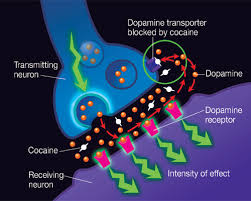
Cocaine is an indirect dopamine agonist. Once in the brain, it works in large part by occupying, or blocking, dopamine transporter sites in the terminal buttons of neurons in the brain. This prevents the reuptake of dopamine by the neurons that release it, allowing higher concentrations of dopamine to remain in the synapse for an extended period of time. This abnormally long presence, and high concentration, of dopamine in the synapse is believed to cause the high associated with cocaine use. Dopamine has been implicated in several important functions, including movement, attention, learning, and the reinforcing effects of drug use. Therefore, its extended presence in high concentrations will be effective in the particular parts of the brain that control these functions, such as the basal ganglia and the limbic system.

The inversion of Cocaine in your brain: Cocaine and the dopamine transporter

Studies have confirmed that the reinforcing effects of cocaine involve dopamine transporter molecules. In a dopamine study, a group of scientists produced a targeted mutation of the gene responsible for production of the dopamine transporter protein in mice. In their findings, it was established that several compensatory mechanisms in an animal’s brain help it to adapt to the chronically higher level of dopamine resulting from their mutation induced reuptake inability. One of these mechanisms is a large decrease in post-synaptic dopamine receptors, rendering dopamine less effective. Another strategy is a corresponding decrease in the concentration of tyrosine hydroxylase (enzyme responsible for the synthesis of dopamine), decreasing the availability of dopamine. So, when cocaine was administered to these animals, it had no effect on the animal’s behavior since dopamine reuptake no longer occurred due to lack of functional dopamine transporters. This therefore is a demonstration that the dopamine transporter is essential for cocaine to be able to produce its effects.

The inversion of Cocaine in your brain: A quick fix

Cocaine has an extremely rapid euphoric effect on the user, especially in the case of the smoking method of use, because the drug directly enters the pulmonary blood stream when smoked. Cocaine has a relatively short half-life in the plasma and in the brain. When administered intravenously (IV) to humans, the half-life is in the range of 16 to 87 minutes. This short half-life accounts for the rapid euphoric effects of the drug. Typically, when the drug is administered intravenously, it produces a fast “hit-and-run” effect on the potentiation of the extracellular levels of dopamine. Nonetheless when rats are given a continuous flow of dopamine intravenously, they experience a peak in dopamine levels in just 10 minutes followed by a return to regular levels after 20 to 30 minutes. Because the initial high experienced by cocaine abusers lasts for only a short time, the initial stimulatory actions of cocaine can be attributed to the elevation of synaptic dopamine levels.

Finally the use of drugs not necessarily cocaine is not your portion. Nothing actually comes good out of the use or abuse of drugs in whichever way you look at it. Being safe and free from drugs is the best thing you can do for yourself especially if you are already deeply addicted to it. There is help around you and doctor Dalal Akoury made one of the best decisions to give her professional contribution in helping the struggling societies with addiction. She decided to create a medical center whose main objective is to transform each individual’s life through increasing awareness about health and wellness and by empowering individuals to find their own inner healing power. You can also be part of this by scheduling for an appointment with her today and your life will be completely transformed for greater productivity ahead of you. Remember that doctor Akoury’s practice focuses on personalized medicine through healthy lifestyle choices that deal with primary prevention and underlying causes instead of patching up symptoms and this will be very good for you too.

The inversion of Cocaine in your brain: Effects of Cocaine in the Nerve system


Facebooktwitterpinterestlinkedin

The Journey of Heroin addiction in Neighborhoods

The Journey of Heroin addiction in Neighborhoods: Why heroin is spreading in America’s suburbs

The Journey of Heroin addiction in Neighborhoods

The Journey of Heroin addiction in Neighborhoods begins with a simple urge to experiment

The cry of the society about the impact of drug addiction and in particularly heroin is making strides in to very unusual territories. It is no longer the preserve of the dangerous canners at the back yards in the city centers. It is moving into our homesteads and door steps to the disbelief of the authorities and parents. If you are in doubt then listen to this story of a college student whose name we are going to withheld and call him Felix. The story of Felix is a clear manifestation of the journey of heroin addiction in neighborhoods. To expose the picture clearly, expert at AWAREmed Health and Wellness Resource Center under the able leadership of doctor Dalal Akoury who is the MD and founder of the facility states that “the drug has followed prescription painkillers into new neighborhoods, an element that has surprised even the police and parents into confronting the unexpected problem.”

The Journey of Heroin addiction in Neighborhoods: The sequence of Heroin addiction

And now back to the story of Felix, he was a good student in school always scoring above-average grades. He seemed poised and self-possessed, and like many of his friends in his charming coastal town north of their town was an incredible path to the college. Then, during his freshman year in high school, he decided to experiment with drugs and alcohol. And this is how it often begins they call it experiment no wonder Felix is following suit. It was on one night when he got very drunk in company of his friends and guess what? He loved it acknowledging that it made his day and that he felt like he has always wanted to be. Before long he was smoking cigarette and marijuana. Soon after a friend graduated him to some prescription painkiller pills which made him feel even much better than alcohol and other drugs he had been taking. Because of the experience he had, he begun purchasing these painkillers secretly and unlawfully spending all his up keep money on this unworthy habit. When he could not get further funding for the same, he resorted into stealing to support his habit but even with the stolen money it was not adequate. The trend continued and his friends introduced him to heroin which was much cheaper. His response was mutual “isn’t heroin for drug addicts?”

The Journey of Heroin addiction in Neighborhoods: High dependency on Drugs leads to Addiction of the same

Yes his concern was realistic but by that time his dependence on the painkillers had become more than he could resist. And as usual he bought the heroin, snorting the powder for the very first time. Oh mu goodness, six days later he was injecting himself with a needle becoming the archetype of a classic heroin addict. His anguished journey from conscientious student to heroin user is one confronting many young people in suburbs across the country and the world over. It has become a thorn in everyone’s flesh and both parents and police are struggling with the ever rising usage of heroin in suburban neighborhoods than ever before.

According to the experts at AWAREmed Health and Wellness Resource Center the rise is being driven by a large supply of cheap heroin in its purer concentrations that can be inhaled or smoked and which often removes the stigma associated with injecting it with a needle. But much of the increase among suburban teens, as well as a growing number of adults, has also coincided with a sharp rise in the use of prescription painkiller pills, which medical experts say are essentially identical to heroin. These painkillers, or opioids, are prescribed for things such as sports injuries, dental procedures, or chronic back pain. Yet in a disturbing number of cases, experts say, they are leading to overdependence and often to addiction to the pills themselves, which can then lead to heroin use.

The Journey of Heroin addiction in Neighborhoods: The indiscriminate nature of Heroin Addiction

Heroin like any other drug does not discriminate on who will be vulnerable to it. It affects everyone irrespective of their social status. If you were to be taken down the history of heroin addiction in various societies the world over, you will be amazed at the kind of personalities that have fallen for heroin. The latest rise in heroin abuse was made more visible by the recent overdose death of actor Philip Seymour Hoffman. Even though this is one of the notable cases, drug addiction has been growing steadily across many levels of society for at least the past decade. And unlike the heroin surge in the 1970s, the current use of opiates is far more concentrated among suburban and rural whites than among African-American and Latino communities taking the US as an example.

In Vermont, Gov. Peter Shumlin in January devoted his entire State of the State message to the heroin and opiate addiction crisis engulfing his state. In Massachusetts, law enforcement authorities recently reported that 185 people have died of heroin overdoses in just the past four months which didn’t include numbers from the state’s three largest cities. Nationwide, according to the federal Substance Abuse and Mental Health Services Administration (SAMHSA), heroin use among persons age 12 and above nearly doubled between 2007 and 2012.

Doctor Akoury states that the perception which used to be in the past that heroin was mostly an urban problem is no longer the case because now there are no borders; there are no demographic or geographic areas which are immune from heroin. The story of Felix will continue in our next article but for now, you and I need to join hand together in the fight of drug abuse. We can allow the journey to heroin addiction in collages, neighborhood or any other place to continue. You can talk to doctor Dalal Akoury for assistance of any kind if you or any of your loved ones is struggling with heroin or and other drug. Your break through with this life threatening condition is going to commence the moment you schedule for that appointment with doctor Akoury today. With her over two decades of delivering professionalism in addiction recovery treatment, you will be well taken care of and your life will never be the same again.

The Journey to Heroin addiction in Colleges: Why heroin is spreading in America’s suburbs


Facebooktwitterpinterestlinkedin

Testing for toxic substances and Detoxification therapies

Testing for toxic substances and Detoxification therapies: The Experts opinion

Testing for toxic substances and Detoxification therapies

Testing for toxic substances and Detoxification therapies. There are very important for holistic body detox.

Detoxification specialists use a variety of tests to determine the causes contributing to toxic conditions. These causes include infections, allergies, addictions, toxic chemicals, and digestive and organ dysfunction. Blood, urine, stool, and hair analyses, as well as allergy tests, are used to measure a variety of bodily functions that may indicate problems. Detoxification therapists usually have access to laboratories that specialize in sophisticated diagnostic tests for toxic conditions. This is very helpful in testing for toxic substances and detoxification therapies thereafter. People who have toxemia are often vulnerable to infection because their immune systems are weakened. Infections can be caused by parasites, bacteria, viruses, and common yeast. Therapists will screen patients for underlying infections that may be contributing to illness.

Doctor Dalal Akoury says that for good result, the liver function must be studied closely with blood and urine tests because the liver is the principle organ in the body responsible for removing toxic compounds. When the liver detoxifies a substance from the body, it does so in two phases. Tests are performed that indicate where problems may be occurring in these phases, which may point to specific types of toxins. Blood and urine tests can also be completed that screen for toxic chemicals such as PCBs (environmental poisons), formaldehyde (a common preservative), pesticides, and heavy metals.

Another useful blood test is a test for zinc deficiency, which may reveal heavy metal poisoning. Hair analysis is used to test for heavy metal levels in the body. Blood and urine tests check immune system activity, and hormone levels can also indicate specific toxic compounds. A 24-hour urine analysis, where samples are taken around the clock, allows therapists to determine the efficiency of the digestive tract and kidneys. Together with stool analysis, these tests may indicate toxic bowel syndrome and digestive system disorders. Certain blood and urine tests may point to nutritional deficiencies and proper recovery diets can be designed for patients as well.

Detoxification therapists may also perform extensive allergy and hypersensitivity tests. Intradermal (between layers of the skin) and sublingual (under the tongue) allergy tests are used to determine a patient’s sensitivity to a variety of common substances, including formaldehyde, auto exhaust, perfume, tobacco, chlorine, jet fuel, and other chemicals.

Food allergies require additional tests because these allergies often cause reactions that are delayed for several days after the food is eaten. The RAST (radio allegro sorbent test) is a blood test that determines the level of antibodies (immune-globulins) in the blood after specific foods are eaten. The cytotoxic test is a blood test that determines if certain substances affect blood cells, including foods and chemicals. The ELISA-ACT (enzyme-linked immune-serological assay activated cell test) is considered to be one of the most accurate tests for allergies and hypersensitivity to foods, chemicals, and other agents. Other tests for food allergies are the elimination and rotation diets, in which foods are systematically evaluated to determine the ones that are causing problems.

Before the therapist could do anything on the patient, it is important that they first carry out an evaluation on the patient and counsel patients closely to determine and correct lifestyle, occupational, psychological, and emotional factors that may also be contributing to illness. Up on establishing this, then treatment can commence. We at the home of solution (AWAREmed Health and Wellness Resource Center) a facility established by doctor Dalal Akoury will just do that to make sure that not stone is left unturned. We understand what is happening to you and testing for toxic substances and detoxification therapies are very powerful tools of reinstating your health to perfection. You can talk to us today by scheduling for an appointment with doctor Dalal Akoury and we will not disappoint.

Testing for toxic substances and Detoxification therapies: Detoxification therapies

Detoxification therapists use a variety of healing techniques after a diagnosis is made. The first step is to eliminate a patient’s exposure to all toxic or allergenic substances. These include heavy metals, chemicals, radiation (from x-rays, power lines, cell phones, computer screens, and microwaves), smog, polluted water, foods, drugs, caffeine, alcohol, perfume, excess noise, and stress. If mercury poisoning has been determined, the patient will be advised to have mercury fillings from the teeth removed, preferably by a holistic dentist.

  • Specific treatments are used to stimulate and assist the body’s detoxification process. Dietary change is immediately enacted, eliminating allergic and unhealthy foods, and emphasizing foods that assist detoxification and support healing.
  • Detoxification diets are generally low in fat, high in fiber, and vegetarian with a raw food emphasis. Processed foods, alcohol, and caffeine are avoided.
  • Nutritional supplements such as vitamins, minerals, antioxidants, amino acids, and essential fatty acids are often prescribed.
  • Spirulina is a sea alga that is frequently given to assist in eliminating heavy metals.
  • Lipotropic agents are certain vitamins and nutrients that promote the flow of bile and fat from the liver.
  • Many herbal supplements are used in detoxification therapies as well. Milk thistle extract, called silymarin, is one of the more potent herbs for detoxifying the liver.
  • Naturopathy, Ayurvedic medicine, and traditional Chinese medicine (TCM) recommend numerous herbal formulas for detoxification and immune strengthening. If infections or parasites have been found, these are treated with herbal formulas and, in difficult cases, antibiotics.
  • For toxic bowel syndrome and digestive tract disorders, herbal laxatives and high fiber foods such as psyllium seeds may be given to cleanse the digestive tract and promote elimination.
  • Colonics are used to cleanse the lower intestines. Digestive enzymes are prescribed to improve digestion, and acidophilus and other friendly bacteria are reintroduced into the system with nutritional supplements.

Chelation therapy is used by detoxification specialists to rid the body of heavy metals. Chelates are particular substances that bind to heavy metals and speed their elimination. Homeopathic remedies have also been shown to be effective for removing heavy metals.

Sweating therapies can also detoxify the body because the skin is a major organ of elimination. Sweating helps release those toxins that are stored in the subcutaneous (under the skin) fat cells. Saunas, therapeutic baths, and exercise are some of these treatments. Body therapies may also be prescribed, including massage therapy, acupressure, shiatsu, manual lymph drainage, and polarity therapy. These body therapies seek to improve circulatory and structural problems, reduce stress, and promote healing responses in the body. Mind/body therapies such as psychotherapy, counseling, and stress management techniques may be used to heal the psychological components of illness and to help patients overcome their negative patterns contributing to illness.

Testing for toxic substances and Detoxification therapies: Practitioners and treatment costs

The costs of detoxification therapies can vary widely, depending on the number of tests and treatments required. Detoxification treatments can be lengthy and involved since illnesses associated with toxic conditions usually develop over many years and may not clear up quickly. Detoxification treatments may be lengthy because they often strive for the holistic healing of the body, mind, and emotions.

Practitioners may be conventionally trained medical doctors with specialties in environmental medicine or interests in alternative treatment. The majority of detoxification therapists are alternative practitioners, such as naturopaths, homeopaths, ayurvedic doctors, ortraditional Chinese doctors.

Insurance coverage varies, depending on the practitioner and the treatment involved. Consumers should review their individual insurance policies regarding treatment coverage.

Testing for toxic substances and Detoxification therapies: Side effects

During the detoxification process, patients may experience side effects of fatigue, malaise, aches and pains, emotional duress, acne, headaches, allergies, and symptoms of colds and flu. Detoxification specialists claim that these negative side effects are part of the healing process. These reactions are sometimes called healing crises, which are caused by temporarily increased levels of toxins in the body due to elimination and cleansing.

Testing for toxic substances and Detoxification therapies: The Experts opinion


Facebooktwitterpinterestlinkedin