Category Archives: Men’s Health

Signs and Symptoms of Lyme disease

Signs and Symptoms of Lyme disease-Elaborate

symptoms

the signs and symptoms of Lyme disease may take long to appear but when they come, the form patches on the skin.

The signs and symptoms of Lyme disease vary and usually affect more than one system. The skin, joints and nervous system are affected most often. In some people, the rash may spread to other parts of the body and, several weeks to months after you’ve been infected, you may experience:

  • Joint pain. You may develop bouts of severe joint pain and swelling. Your knees are especially likely to be affected, but the pain can shift from one joint to another.

Signs and Symptoms of Lyme disease-How Is Lyme disease Transmitted?

Lyme disease is transmitted through a bite from a specific type of tick. The animals that most often carry these insects are white-footed field mice, deer, raccoons, opossums, skunks, weasels, foxes, shrews, moles, chipmunks, squirrels, and horses. The majority of these ticks have been found in New York, Connecticut, Massachusetts, Maryland, New Jersey, Minnesota, and Wisconsin.

What are Signs and Symptoms of Lyme disease?

These signs and symptoms may occur within a month after you’ve been infected:

  • Rash. A small, red bump may appear at the site of the tick bite. This small bump is normal after a tick bite and doesn’t indicate Lyme disease. However, over the next few days, the redness may expand forming a rash in a bull’seye pattern, with a red outer ring surrounding a clear area. The rash, called erythema migrans, is one of the hallmarks of Lyme disease. Some people develop this rash at more than one place on their bodies.
  • Flu-like symptoms. Fever, chills, fatigue, body aches and a headache may accompany the rash.

However in the early stages of Lyme disease, you may experience flu-like symptoms that can include a stiff neck, chills, fever, swollen lymph nodes, headaches, muscle aches, and joint pain. You may also experience a large, expanding skin rash around the area of the tick bite. In more advanced disease, nerve problems and arthritis, especially in the knees, may occur.

Here are some more details:

  • Erythma migrans: is the telltale rash which occurs in about 70% to 80% of cases and starts as a small red spot that expands over a period of days or weeks, forming a circular, triangular, or oval-shaped rash. Sometimes the rash resembles a bull’s-eye because it appears as a red ring surrounding a central clear area. The rash, which can range in size from that of a dime to the entire width of a person’s back, appears between three days and a few weeks of a tick bite, usually occurring at the site of a bite. As infection spreads, several rashes can appear at different sites on the body.

Erythema migrans is often accompanied by symptoms such as fever, headache, stiff neck, body aches, and fatigue. These flu-like symptoms may resemble those of common viral infections and usually resolve within days or a few weeks.

  • Arthritis. After several weeks of being infected with Lyme disease, approximately 60% of those people not treated with antibiotics develop recurrent attacks of painful and swollen joints that last a few days to a few months. The arthritis can shift from one joint to another; the knee is most commonly affected and usually one or a few joints are affected at any given time. About 10% to 20% of untreated patients will go on to develop lasting arthritis. The knuckle joints of the hands are only very rarely affected.
  • Neurological symptoms. Lyme disease can also affect the nervous system, causing symptoms such as stiff neck and severe headache (meningitis), temporary paralysis of facial muscles (Bell’s palsy), numbness, pain or weakness in the limbs, or poor coordination. More subtle changes such as memory loss, difficulty with concentration, and a change in mood or sleeping habits have also been associated with Lyme disease. People with these latter symptoms alone usually don’t have Lyme disease as their cause.

Nervous system abnormalities usually develop several weeks, months, or even years following an untreated infection. These symptoms often last for weeks or months and may recur. These features of Lyme disease usually start to resolve even before antibiotics are started. Patients with neurologic disease usually have a total return to normal function.

  • Heart problems. Relatively small number of people of about less than one out of 10 Lyme disease patients develops heart problems, such as an irregular, slow heartbeat, which can be signaled by dizziness or shortness of breath. These symptoms rarely last more than a few days or weeks. Such heart abnormalities generally appear several weeks after infection, and usually begin to resolve even before treatment.
  • Other symptoms. Less commonly, Lyme disease can result in eye inflammation and severe fatigue, although none of these problems is likely to appear without other Lyme disease symptoms being present.

Signs and Symptoms of Lyme disease-When to see a doctor

If you’ve been bitten by a tick and experience symptoms: Only a minority of deer tick bites leads to Lyme disease. The longer the tick remains attached to your skin, the greater your risk of getting the disease. If you think you’ve been bitten and experience signs and symptoms of Lyme disease — particularly if you live in an area where Lyme disease is prevalent — contact your doctor immediately. Treatment for Lyme disease is most effective if begun early.

See your doctor even if the symptoms disappears: it’s important to consult your doctor even if signs and symptoms disappear because the absence of symptoms doesn’t mean the disease is gone. Left untreated, Lyme disease can spread to other parts of your body from several months to years after infection causing arthritis and nervous system problems. Ticks also can transmit other illnesses, such as babesiosis and Colorado tick fever.

Finally Lyme disease imitates a variety of illnesses and its severity can vary from person to person. If you have been bitten by a tick and live in an area known to have Lyme disease, see your doctor right away so that a proper diagnose can be made and treatment started.

Signs and Symptoms of Lyme disease-Elaborate


Facebooktwitterpinterestlinkedin

Prevention of Lyme Disease

Prevention of Lyme Disease-It is possible

Prevention

whatever it take avoid such places and prevent Lyme disease from attacking you and family

As it is always said that prevention is better than cure, it will be very important to take keen interest in the prevention of this problem. The best way to prevent Lyme disease would be to avoid areas where deer ticks live, especially wooded, bushy areas with long grass. You can reduce your risk of getting Lyme disease by taking some simple precautions like:

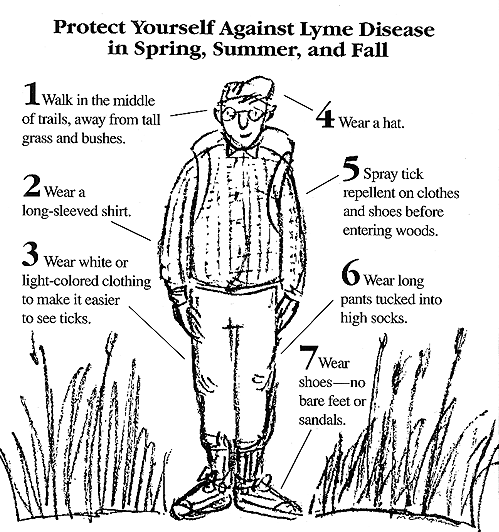
  • Wear long pants and long sleeves. When walking in wooded or grassy areas, wear shoes, long pants tucked into your socks, a long-sleeved shirt, a hat and gloves. Try to stick to trails and avoid walking through low bushes and long grass. Keep your dog on a leash.
  • Use insect repellents. Apply an insect repellent with a 20 percent or higher concentration of DEET to your skin. Parents should apply to their children, avoiding their hands, eyes and mouth. Keep in mind that chemical repellents can be toxic, so follow directions carefully. Apply products with permethrin to clothing or buy pretreated clothing.
  • Do your best to tick-proof your yard. Clear brush and leaves where ticks live. Keep woodpiles in sunny areas.
  • Check yourself, your children and your pets for ticks. Be especially vigilant after spending time in wooded or grassy areas. Deer ticks are often no bigger than the head of a pin, so you may not discover them unless you search carefully. It’s helpful to shower as soon as you come indoors. Ticks often remain on your skin for hours before attaching themselves. Showering and using a washcloth may be enough to remove any unattached ticks.
  • Don’t assume you’re immune. Even if you’ve had Lyme disease before, you can get it again.
  • Remove a tick as soon as possible with tweezers. Gently grasp the tick near its head or mouth. Don’t squeeze or crush the tick, but pull carefully and steadily. Once you’ve removed the entire tick, dispose of it and apply antiseptic to the bite area.

Prevention of Lyme disease-How to reduce Tick bites

  • Avoid tick-infested areas, such as leaf litter under trees. Avoid brushing against long grasses and brush on edges of paths. Don’t sit on stumps or fallen logs.
  • Wear light-colored long pants and long sleeves so you can easily see any ticks.
  • Tuck shirt into pants and tuck pants into socks.
  • Use DEET on skin and treat clothing with spray containing permethrin.
  • Do a thorough tick check upon returning inside and for several days following exposure.
  • Check bedding for several days following exposure for ticks that drop off.
  • Ticks, especially nymphal ticks, are tiny. Find and remove them before they bite.

Prevention of Lyme disease-What to do if you are bitten

  • Use fine-point tweezers or a special tick-removing tool. Grasp the tick as close to the skin as possible. If you don’t have tweezers, protect your fingers with a tissue.
  • Pull the tick straight out with steady, even pressure to view a Tick’s Mouth and why it is so important to pull out the tick correctly.
  • Avoid squeezing the tick, breaking it, or allowing any blood to remain on your skin.
  • Place the tick in a small plastic bag or vial with blades of grass, leaf, or moist (not wet) piece of tissue.
  • Label the bag with your name, date, site of bite and how long tick was attached.
  • Have the tick identified and tested by a lab, health department or veterinarian.
  • Wash your hands, disinfect the tweezers and bite site.
  • Educate yourself about tick-borne diseases and consult a doctor to see if treatment is warranted.

Considerations for Prophylactic (Preventive) Treatment

  • The tick infection rate in the area where you acquired the tick. An area may still labeled as “no risk” despite lack of scientific studies.
  • The relative risk of transmission, depending on whether the tick was a nymph or adult, duration of attachment and how it was removed.
  • Whether the tick tested positive for a tick-borne infection.
  • The Lyme germs may spread widely in the body, including to the brain, within hours/days.
  • The cost of prophylactic treatment vs. risk of infection.
  • The risks and benefits of prophylactic treatment vs. risks of infection.

Other protective ways

  • Reduce ticks on your property by
  • pruning trees
  • clearing brush
  • removing litter
  • Mowing grass short, and letting it dry thoroughly between watering.
  • Move shrubbery and overgrowth farther away from areas frequented by people.
  • Make your property unattractive to animals that are hosts to ticks by:
  1. Eliminating birdfeeders, birdbaths, and salt licks;
  2. Erecting fencing around the property;
  3. clearing away woodpiles, garbage, and leaf piles;
  4. Removing stonewalls that provide homes to wildlife.
  5. Have your property chemically treated.
  6. You can kill ticks on your property by applying chemicals. Seek professional advice before application. Carefully timed applications increase effectiveness.

Also Consider These Important Facts:

  • If you tuck pants into socks and shirts into pants, be aware that ticks will climb upward to hidden areas of the head and neck, so spot-check clothes frequently.
  • Clothes can be sprayed with DEET or treated with permethrin. Follow label instructions carefully.
  • Upon returning home, clothes can be put in a high temperature dryer for 20 minutes to kill any unseen ticks.
  • Any contact with vegetation, even playing in the yard, can result in exposure to ticks. Frequent tick checks should be followed by a whole-body examination and tick removal each night. This is the single most effective method for prevention of Lyme disease.

Prevention of Lyme Disease-Safely removal Tick

If you DO find a tick attached to your skin, do not panic. Not all ticks are infected, and your risk of Lyme disease is greatly reduced if the tick is removed within the first 36 hours. To remove a tick, ensure that you:

  • Use a pair of pointed tweezers to grasp the tick by the head or mouth parts right where they enter the skin. DO NOT grasp the tick by the body.
  • Pull firmly and steadily outward. DO NOT jerk or twist the tick.
  • Place the tick in a small container of rubbing alcohol to kill it.
  • Clean the bite wound with rubbing alcohol or hydrogen peroxide.
  • Monitor the site of the bite for the next 30 days for the appearance of a rash. If you develop a rash or flu-like symptoms, contact your health care provider immediately. Although not routinely recommended, taking antibiotics within three days after a tick bite may be beneficial for some persons. This would apply to deer tick bites that occurred in areas where Lyme disease is common and there is evidence that the tick fed for more than one day. In cases like this you should discuss the possibilities with your doctor or health care provider.

Prevention of Lyme Disease-It is possible


Facebooktwitterpinterestlinkedin

How common is addiction in healthcare

How common is addiction in healthcare-Addressing Specialties risks

Healthcare

As many as 10% of those in healthcare are battling addiction, professionals battling with drug addiction is seem extreme .

Physicians treated for addiction have recently become the focus of high quality, evidence based outcome research published in peer-reviewed journals. The results of this research indicate that the treatment of physicians is profoundly effective when properly executed. As a policy there are  three important areas of addiction among healthcare and other licensed professionals, including issues related to stigma, the effective response to the problem of addiction among professionals, and the interrelation and integration of medical, legal, and sociological issues regarding addiction in this particular population.

Several factors are involved in the etiological differences of addiction as it manifests in the special population of healthcare and other licensed professionals.

First, one group of professionals (healthcare providers) have greater access to addictive drugs in their workplace, which can accelerate and complicate the onset and progression of the disease.

Secondly, healthcare professional training creates a level of comfort and an associated false sense of immunity to the dangers of drug use. Having technical knowledge about the pharmacology of drugs does not protect susceptible individuals from becoming addicted to such drugs and, in fact, may actually predispose susceptibility.

Thirdly, all healthcare and other licensed professionals with addictive illness face tremendous prejudice based on stigma and fear which make them hesitant to admit a problem or seek assistance. Lastly and importantly, as with other safety-sensitive occupations, healthcare and other licensed professionals with untreated, potentially impairing conditions have the potential to place the public at risk.

Many individuals and agencies play a role in the care and coordination of the addicted healthcare and other licensed professionals. For the purposes of this article, we have focused on four critical entities:

  1. The population of healthcare and other licensed professionals with the disease of addiction.
  2. The specialty treatment programs where these persons receive clinical care.
  3. The various Physicians / Professionals Health Programs (PHPs) which provide continuing care monitoring and earned advocacy.
  4. State-specific license agencies and other comparable regulatory agencies.

These entities, as defined, have an interrelated and often symbiotic role in both the successful rehabilitation and recovery of the addicted professional, and the safety and welfare of the public.

How common is addiction in healthcare-The Addicted Professional

The disease of addiction produces characteristic behaviors. The characteristics and circumstances of the patient who is, himself or herself, a professional are unique. These issues be considered and managed during treatment and post-treatment recovery. These policies address physician patients who are part of a professional cohort; but include other licensed professionals including, but not limited to, nurses, physician assistants, pharmacists, psychologists, commercial pilots, attorneys, law enforcement officials, as well as any cohort who provides a public service that could impact the public health, safety, and welfare. Each of these groups is unique in the perception of their disease, their experience of addiction-induced shame, and the necessary coping skills to ensure successful long-term recovery.

Some of these professional groups share strong similarities; however, each specific group should be treated by providers knowledgeable, skilled and experienced in understanding the distinctive educational background, psychological characteristics, work environment, professional culture, social factors, and specific licensure and regulatory agency processes related to each particular cohort of addiction treatment recipients.

How common is addiction in healthcare-Addiction Treatment Programs for Healthcare (ATPs)

Addiction Treatment Programs for healthcare and other licensed professionals specialize in the diagnosis and treatment of addictive and/or mental illnesses in healthcare and other licensed professionals. These clinical programs possess expertise in dealing with issues specific to these populations of ill individuals; some ATPs have expertise in one or more subjects of professionals. ATPs provide a multidisciplinary spectrum of therapeutic services, addressing the biologic, psychosocial, family, and spiritual components of these disease states.

One important element in specialized Addiction Treatment Programs is the presence of a cohort of like-professionals. This peer relating during treatment decreases the isolation and enhances the interdependent learning necessary for effective treatment. ATPs for professionals have extensive experience with and knowledge of the stress and triggers in the work and home environment specific to the professional cohort being treated. This information is used to focus the treatment on cohort-specific issues, encourages reintegration into a healthy home and work environment, and ultimately promotes a sustained successful recovery. The most comprehensive programs manage multiple psychiatric diseases, complex medical conditions, psychological co-morbidity along with a broad spectrum of addictive disorders.

Many facilities that treat addicted professionals provide comprehensive evaluation services as well. Some evaluation programs are organized as separate entities from ATPs, while others are integrated with treatment facilities. Evaluation centers must exhibit a proven track record in understanding the complex multifunctional and insidious nature of addiction among healthcare and other licensed professionals. They should utilize a multidisciplinary team of individuals with specific expertise in distinct but interrelated specialties.
How common is addiction in healthcare-Professionals Health Programs (PHPs)

A Professionals Health Program has mutually symbiotic dual roles of enhancing public safety and facilitating the successful rehabilitation and practice re-entry of healthcare and other licensed professionals with potentially impairing medical conditions. Professionals Health Programs (PHPs) provide a confidential conduit for ill professionals to access a comprehensive evaluation and any necessary subsequent treatment.

When a professional with a potentially impairing illness becomes involved with a Professionals Health Program (PHP) and no harm to the public has been identified, he or she is ideally enrolled in an alternative pathway to professional discipline. PHPs provide the availability of a non-disciplinary alternative with rehabilitation and accountability being emphasized, facilitated, and carefully documented over time. The PHPs continuous, skilled and documented monitoring of the professionals recovery status and associated earned advocacy further promotes the public safety.

PHPs are exceptionally distinct in their ability to provide early identification, intervention, and referral for evaluation and/or treatment. They also conduct three types of post-treatment monitoring: behavioral, chemical, and work-site evaluations. Their success is largely attributable to this tri-partite model of recovery monitoring. The intervention, referral and post-treatment monitoring services offered by PHP’s are generally conceptualized as being distinct from the clinical services offered by ATPs.

PHPs educate the medical community about addiction among professionals, the risks of addiction in professionals and the recognition of the subtle signs and symptoms of addiction in the workplace. Such education and prevention services further enhance public safety by encouraging earlier detection and referral to treatment when appropriate.
How common is addiction in healthcare-Regulatory Agencies (RAs)

These are agencies of state government charged with credentialing and granting licenses to professionals and assuring to the public at large that the conduct of the professional meets professional and statutory standards. State statutes mandate the regulation of selected professions to ensure the delivery of quality healthcare or other services necessary to the public health, safety, and welfare. They investigate the practice of licensees and have authority to address those who violate the state’s professional practice acts or comparable legislation. Their primary mission is to protect the public.

Addiction rehabilitation requires an understanding of the inter-organizational complexities along with associated expertise in the interrelated management of addicted professionals to the benefit of the public we serve. This understanding of addiction rehabilitation among professionals facilitates the interaction by and between Addiction Treatment Programs, Regulatory Agencies, and the Professionals Health Programs.

How common is addiction in healthcare-Addressing Specialties risks


Facebooktwitterpinterestlinkedin

Addiction in health care professionals

Addiction in health care professionals-The untold story

addiction

One group of professionals (healthcare providers) have greater access to addictive drugs in their workplace, which can accelerate addiction

The abuse of prescription drugs-especially controlled substances-is a serious social and health problem in most states today. People addicted to prescription medication come from all walks of life. The last people we would suspect of drug addiction are health care professionals-those people trusted with our well-being in issuance of medically correct drugs. Unfortunately, health care workers are as likely and are vulnerable as anyone else to abuse drugs.

The vast majority of Drug Enforcement Agency (DEA) registered practitioners comply with the controlled substances law and regulations as stipulated in various laws in different states. However, drug impaired health professionals are one source of controlled substances diversion. Many have easy access to controlled substance medications. Some will divert and abuse these drugs for reasons such as relief from stress, self-medication, or to improve work performance and alertness.

Addiction in healthcare professionals-Responsibilities of DEA

DEA-registered health practitioners have a legal and ethical responsibility to help protect society from drug abuse. They have a professional responsibility to prescribe and dispense controlled substances appropriately and decisively to the consumers. They guard against abuse while ensuring that patients have medication available when they need it. They have a personal responsibility to protect their practice from becoming an easy target for drug diversion, in other words they ore all the patient the duty of care in all respect and discipline. They must become aware of the potential situations where drug diversion can occur and what to do to prevent it well before it happen. The safety of the patients must be their ultimate objective and at no given time must this change or be seen to be changing.

Addiction in healthcare professionals-Recognizing a drug impaired coworker

Drug abusers often exhibit similar unusual behavior. The following signs and symptoms may indicate a drug addiction problem in a health care professional:

  • Absences from work without notification and an excessive number of sick days used
  • Frequent disappearances from the work site-frequent or long trips to the bathroom or to the stockroom where drugs are kept
  • Excessive amounts of time spent near a drug supply
  • Volunteering for overtime and working when not scheduled to be there
  • Unreliability in keeping appointments and meeting deadlines
  • Work performance which alternates between periods of high and low productivity; mistakes made due to inattention, poor judgment and bad decisions
  • Confusion, memory loss, and difficulty concentrating or recalling details and instructions
  • Ordinary tasks require greater effort and consume more time
  • Strained or neglected interpersonal relations with colleagues, staff and patients
  • Rarely admits errors or accepts blame for errors or oversights
  • Heavy “wastage” of drugs
  • Sloppy record keeping, suspect ledger entries and drug shortages
  • Inappropriate prescriptions for large narcotic doses
  • Insistence on personal administration of injected narcotics to patients
  • Progressive deterioration in personal appearance and hygiene
  • Uncharacteristic deterioration of handwriting and charting
  • Wearing long sleeves when inappropriate
  • Personality changes-mood swings, anxiety, depression, lack of impulse control, suicidal thoughts or gestures
  • Patient and staff complaints about health care provider’s changing attitude/behavior
  • Increasing personal and professional isolation

Addiction in healthcare professionals-The decision to get involved

Health care professionals often avoid dealing with drug impairment in their colleagues. There is the fear that speaking out could anger the coworker, resulting in retribution, or could result in a colleague’s loss of professional practice. Many employers or coworkers end up being “enablers” of health care practitioners whose professional competence has been impaired by drug abuse.

Drug impaired coworkers are often protected from the consequences of their behavior. However if you ever identify any signs or symptoms in a coworker, it will be wise and important that you show great concern towards the fellow staff. Someone’s future could be jeopardized if you cover up and choose not to report your concerns. By becoming involved by way of reporting and showing concern you may be doing several positive things like:

  • Helping someone who may be doing something illegal
  • Protecting the safety and welfare of an addicted employee or coworker
  • Protecting patients or other people who could suffer at the hands of a drug addicted individual
Addiction in healthcare professionals-If drugs are being sold or stolen

If you suspect that a drug deal or syndicate is in progress, do not intervene on your own, this may be dangerous because you may not know how well organized the syndicate is. Contact the organization security or better still notify the police. If you are a DEA registrant and become aware of a theft or significant loss involving controlled substances, you must immediately report the theft or loss. You should go to the nearest DEA office as well as your local police department by doing this you will be helping a great deal on dealing with drug addiction within the healthcare professional sector.

What you can do to help

For some employees, a supervisor talking to them about their poor work performance is enough to help them change. Many drug abusers will seek help for their problem if they believe their job is at stake. This may be true even if they have ignored such pleas from other people important in their life.  A referral to the Employee Assistance Program is often the supervisor’s course of action.

Drug addicts can recover, and effective help is available. Encourage your coworker or employee to seek drug treatment assistance. Treatment programs range from self-help to formal recovery programs. You may suggest they contact the Employee Assistance Program for help in determining the appropriate level of care. The EAP and the treatment programs will maintain the confidentiality of those seeking assistance to the greatest extent possible.

Addiction in health care professionals-The untold story


Facebooktwitterpinterestlinkedin

Lyme disease and Relapse

Lyme disease and Relapse-Reinfection versus Relapse

Erythema migrans.

Relapse

Lyme disease is the most common tick-borne infection in the United States and Europe. Clues to differentiating reinfection from relapse of Lyme disease

During both the initial infection and subsequent episodes, the majority of patients with Lyme disease manifest the distinctive skin lesion erythema migrans. In untreated patients, erythema migrans resolves spontaneously within a median of about twenty eight days, but relapse may occur within a longer period, usually within a year or so of the appearance of the initial lesion. After treatment with presently recommended antibiotic regimens, however, persistence, progression, or recurrence of the skin lesion or the development of objective extra cutaneous manifestations of Lyme disease is exceedingly rare.

Relapse has been well-documented (on the basis of recovery of B. burgdorferi by culture) only in patients treated with antibiotics like cephalexin also known to have poor activity in vitro against this microorganism, although some patients treated with certain macrolides also appear to experience relapse clinically. Thus, the development of a new erythema migrans lesion in a person with a prior history of Lyme disease who was treated with recommended regimens is prima facie evidence for reinfection.

Clinical features that suggest reinfection rather than relapse include the development of an erythema migrans lesion at a site different from that of the original lesion and the presence of a punctum in the lesion. A punctum is a small raised or depressed point near the center of a primary erythema migrans lesion, representing the site from which the tick detached. In the United States, repeat episodes of erythema migrans due to reinfection almost always develop in a subsequent transmission season during the late spring or summer (R.B.N., unpublished data) at the time when nymphal stage (i.e., the stage that is the principal vector for Lyme disease) scapular’s or Ixodes pacificus ticks are most abundant. In Eurasia, reinfection, usually transmitted by nymphal Ixodes ricinus or adult Ixodes persulcatus, is also expected to occur mostly during the late spring or summer. In contrast, cases of relapse of preexisting infection would not necessarily be expected to occur in a seasonal pattern and would be likely to arise within a few weeks to several months after the initial episode.

Lyme disease and Relapse-Differentiating reinfection from relapse

Limited data are available regarding the clinical manifestations of second episodes of erythema migrans in patients with Lyme disease who have reinfection. A recent report described twenty eight patients from Block Island, Rhode Island, who had repeated episodes of erythema migrans and were believed to have been re-infected with B. burgdorferi (five additional persons had only “flu-like illnesses” as either their first or second episode of infection but were considered to have Lyme disease on the basis of seroconversion). None of the patients had clinical evidence of immunodeficiency. Persons with reinfection were equally distributed by sex; however, 6 (86%) of 7 persons who experienced a third episode of Lyme disease were female. This finding is difficult to explain but is consistent with the observations in a recent Swedish study, in which the investigators found that twenty seven of thirty one re-infected persons were women aged 44 years old.

Lyme disease and Relapse-Analysis

As one would predict, nearly all cases of recurrent infection in the Block Island study occurred during the late spring or summer. The number and severity of symptoms were similar in the first and second episodes and appeared to be less severe during the third episode, although these findings were not statistically significant. Surprisingly, all patients with recurrent Lyme disease did not seek medical attention sooner than did those who had only a single episode. That was very interesting.

A preliminary report summarized findings for eleven men and another eleven women with who each experienced two episodes of erythema migrans and were seen at our institution; the episodes occurred a mean (±SD) of 3.25 ± 2.65 years apart. A prior tick bite at the site of erythema migrans was recalled with similar frequency in patients who experienced first and second episodes. Patient symptoms (including fever), diameter of erythema migrans, abnormal findings on physical examination, and laboratory results (complete blood count, transaminase levels, and erythrocyte sedimentation rate) during second episodes were similar to those during first episodes. These findings were also similar to those for contemporaneous control subjects who experienced single episodes of erythema migrans. This study obviously had insufficient power to detect relatively small differences.

In this study, patients were >2 times as likely to have multiple erythema migrans skin lesions (a marker of hematogenous dissemination of B. burgdorferi infection) during their first episode of Lyme disease than during their second episode (7 [32%] patients during the first episode vs. 3 [14%] patients during the second episode; P = .15). Although this finding could be a chance event, alternatively, it could be related to the development of partial host immunity, leading to protection from hematogenous dissemination after reinfection

Lyme disease and Relapse-Reinfection versus Relapse


Facebooktwitterpinterestlinkedin