Tag Archives: Alcohol and cocaine

The long and short term effects of cocaine

The long and short term effects of cocaine: The chronic nature of Cancer
The long and short term effects of cocaine

The long and short term effects of cocaine are all manageable is only preventive measures can be taken

There is no doubt that cocaine is very addictive substance. Its power of addictiveness makes it to be very unpredictable and thus users may not be able to tell or control the extent to which they will continue to want or use the drug. Doctor Akoury says that with these characteristics, if one is to become addicted, the risk for relapse will be very high even after long periods of abstinence. Some studies have established that during periods of abstinence, the memory of the cocaine experience or exposure to cues associated with drug use can trigger tremendous craving and relapse to drug use. It is this craving element that will necessitate the long and short term effects of cocaine which is going to form the basis of this discussion.

Cocaine causes a short-lived, intense high that is immediately followed by the opposite intense depression, edginess and a craving for more of the drug. Users of cocaine often don’t eat or sleep properly. They can experience greatly increased heart rate, muscle spasms and convulsions. The drug can make them feel paranoid, angry, hostile and anxious even when they are just sober and not high. Doctor Akoury says that irrespective of the quantity of drugs used or frequency with which it is used, cocaine increases the vulnerability of addicts into contracting chronic diseases like heart attack, stroke, seizure or respiratory (breathing) failure. These conditions can be life threatening and any of them can result in sudden death.

The long and short term effects of cocaine: What are the long term effects of cocaine?

The phrase “dope fiend” was originally coined many years ago to describe the negative side effects of constant cocaine use. As tolerance to the drug increases, it becomes necessary to take greater and greater quantities to get the same high. Prolonged daily use causes sleep deprivation and loss of appetite. A person can become psychotic and begin to experience hallucinations. And because cocaine interferes with the way the brain processes chemicals, users will in many instances need more and more of the drug just to feel “normal.” People who become addicted to cocaine and even addicts of other drugs may lose interest in other areas of life. Doctor Akoury says that coming down from the drug causes severe depression that an addict will do all that it takes to get the supply even if it would mean that he has to commit murder. In the event that the individual fails to get the drug (cocaine) he or she will suffer even greater depression that can be so much intense that can push them beyond the limit and even turn suicidal. That is the power of cocaine and the reason why we all need to know the long and short term effects of cocaine. This way we will be able to take timely precaution and remedy the situation before it stretches beyond the redeemable levels. Now let us consider some of the long term effect which is associated with cocaine abuse.

The long and short term effects of cocaine: Long term effects

When people abuse cocaine over a period of time, a lot of things can happen in the lives of such individuals. Some of those health implications may include the following:

  • Permanent damage to blood vessels of the heart and the brain
  • High blood pressure that will occasionally leads to other chronic health conditions including heart attacks, strokes and even death
  • The damage of vital organs like the liver, kidney and the lungs
  • Damages of the nose tissues especially when sneezing
  • Respiratory failure if smoked
  • Infectious diseases and abscesses if injected
  • Malnutrition, weight loss
  • Severe tooth decay
  • Auditory and tactile hallucinations
  • Sexual problems, reproductive damage and infertility which will affect both men and women in the same way
  • Disorientation, apathy, confused exhaustion
  • Irritability and mood disturbances
  • Increased frequency of risky behavior
  • Delirium or psychosis
  • Severe depression
  • Tolerance and addiction (even after just one use)

The point we have highlighted may not be conclusive as far as the long term effects is concern. It would be better if you are up to date will all health information surrounding this substance abuse. Such information in their conclusiveness is available at AWAREmed Health and Wellness Resource Center. This is a facility with was founded by doctor Dalal Akoury primarily to offer her exclusive NER Recovery Treatment to everyone including other physicians and health care professionals through training, clinical apprenticeships, webinars and seminars. It may not matter what kind of addiction you are struggling with, there is hope for you with the experts at this facility. All you need to do is to seek for help by scheduling for an appointment with doctor Dalal Akoury any your condition will be professionally addressed timely leaving you to enjoy life to the fullest. In spite of the long term effects of cocaine abuse, there are also other factors which may not necessarily be of long term but of short term. They may include the following:

The long and short term effects of cocaine: Short term effects

  • Loss of appetite causing the addict not to feed properly
  • Intense drug craving
  • Bizarre, erratic, sometimes violent behavior
  • Convulsions, seizures and sudden death from high doses (even one time)
  • Tactile hallucination that creates the illusion of bugs burrowing under the skin
  • Increased heart rate, blood pressure, body temperature
  • Contracted blood vessels
  • Dilated pupils
  • Disturbed sleep patterns
  • Nausea
  • Hyper-stimulation
  • Intense euphoria
  • Depression
  • Panic and psychosis
  • Increased rate of breathing
  • Hallucinations, hyper-excitability, irritability
  • Anxiety and paranoia

Finally it is not just enough to know the long and short term effects of cocaine but it is equally very important that you learn from the past people who had gone through the same experience. And I want to conclude this discussion with a testimony from one former addict who is now sober and he says “don’t touch cocaine. I had to spend four years behind bars just because of this drug (cocaine). And when I got out he continues, life was so hard and unbearable. I started taking the drug again. In this drug business, I have known 10 girls who were full of life but who became prostitutes because of cocaine. It’s much more extreme and degrading than we believe. At the time we don’t realize to what degree it destroys us he concludes.” Choose life and seek for help doctor Akoury will be waiting for your call.

The long and short term effects of cocaine: The chronic nature of Cancer


Facebooktwitterpinterestlinkedin

The inversion of Cocaine in your brain

The inversion of Cocaine in your brain: Effects of Cocaine in the Nerve system

The inversion of Cocaine in your brain

The inversion of Cocaine in your brain. Cocaine has an extremely rapid euphoric effect on the user, especially when smoked or snorted.

Cocaine is very addictive and a psychoactive drug affecting the central nervous system primarily. Originally it is prepared from the leaf of the Erythroxylon coca bush, which grows mainly in Peru and Bolivia. The simplicity of its usage has made the inversion of cocaine in your brain more chronic and threatening. As a matter of facts this drug is self-administered in several ways explains doctor Dalal Akoury. The most common method of cocaine abuse is snorting in its powder form into the nasal sinuses, either alone or with the accompaniment of heroin (speedball). This drug is easily available in the streets as a hydrochloride salt which is a fine, white crystalline powder known in several street manes as coke, C, snow, flake, or blow. Besides snorting, the drug can also be administered through smoking which for many is effective in producing quick result as crack cocaine.

According to the experts at AWAREmed Health and Wellness Resource Center, cocaine produces a wide range of physiological effects in humans, including the stimulation of a plethora of emotional experiences. When people take in cocaine, they become euphoric, over exited, highly active and more talkative than normal. When they use this drug, they experience the feelings of extreme power and alertness. This initial high is followed by sessions of severe anxiety, paranoia, and depression, which often lead to addiction. Those who become addicted to the drug often turn the habit into an obsession, so that they devote more, and more of their time and money to acquiring and using the drug explains doctor Akoury. Therefore what are some of the notable symptoms of addiction for users?

The inversion of Cocaine in your brain: Symptoms of addiction

People who abuse these drugs regularly often exhibit psychotic behavior such as:

  • Hallucinations
  • Delusions of persecution
  • Mood disturbances
  • Repetitive behaviors

All these closely resemble the symptoms of paranoid schizophrenia. Trained mental health professionals have difficulties in telling a schizophrenic and cocaine addict apart unless they know the patient’s background. Although the psychological and behavioral effects of cocaine use in humans have been well documented, the current knowledge of the neurological basis for the abuse of cocaine in humans is still limited. The majority of knowledge we possess about the mechanisms of the effects of cocaine comes from animal studies performed over the last 20 years. These studies have clearly demonstrated the crucial role of the neurotransmitter dopamine in initiating many of the effects of cocaine use.

The inversion of Cocaine in your brain: Effects on the brain

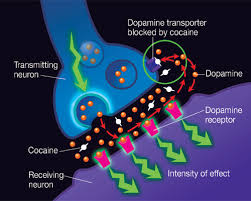
Cocaine is an indirect dopamine agonist. Once in the brain, it works in large part by occupying, or blocking, dopamine transporter sites in the terminal buttons of neurons in the brain. This prevents the reuptake of dopamine by the neurons that release it, allowing higher concentrations of dopamine to remain in the synapse for an extended period of time. This abnormally long presence, and high concentration, of dopamine in the synapse is believed to cause the high associated with cocaine use. Dopamine has been implicated in several important functions, including movement, attention, learning, and the reinforcing effects of drug use. Therefore, its extended presence in high concentrations will be effective in the particular parts of the brain that control these functions, such as the basal ganglia and the limbic system.

The inversion of Cocaine in your brain: Cocaine and the dopamine transporter

Studies have confirmed that the reinforcing effects of cocaine involve dopamine transporter molecules. In a dopamine study, a group of scientists produced a targeted mutation of the gene responsible for production of the dopamine transporter protein in mice. In their findings, it was established that several compensatory mechanisms in an animal’s brain help it to adapt to the chronically higher level of dopamine resulting from their mutation induced reuptake inability. One of these mechanisms is a large decrease in post-synaptic dopamine receptors, rendering dopamine less effective. Another strategy is a corresponding decrease in the concentration of tyrosine hydroxylase (enzyme responsible for the synthesis of dopamine), decreasing the availability of dopamine. So, when cocaine was administered to these animals, it had no effect on the animal’s behavior since dopamine reuptake no longer occurred due to lack of functional dopamine transporters. This therefore is a demonstration that the dopamine transporter is essential for cocaine to be able to produce its effects.

The inversion of Cocaine in your brain: A quick fix

Cocaine has an extremely rapid euphoric effect on the user, especially in the case of the smoking method of use, because the drug directly enters the pulmonary blood stream when smoked. Cocaine has a relatively short half-life in the plasma and in the brain. When administered intravenously (IV) to humans, the half-life is in the range of 16 to 87 minutes. This short half-life accounts for the rapid euphoric effects of the drug. Typically, when the drug is administered intravenously, it produces a fast “hit-and-run” effect on the potentiation of the extracellular levels of dopamine. Nonetheless when rats are given a continuous flow of dopamine intravenously, they experience a peak in dopamine levels in just 10 minutes followed by a return to regular levels after 20 to 30 minutes. Because the initial high experienced by cocaine abusers lasts for only a short time, the initial stimulatory actions of cocaine can be attributed to the elevation of synaptic dopamine levels.

Finally the use of drugs not necessarily cocaine is not your portion. Nothing actually comes good out of the use or abuse of drugs in whichever way you look at it. Being safe and free from drugs is the best thing you can do for yourself especially if you are already deeply addicted to it. There is help around you and doctor Dalal Akoury made one of the best decisions to give her professional contribution in helping the struggling societies with addiction. She decided to create a medical center whose main objective is to transform each individual’s life through increasing awareness about health and wellness and by empowering individuals to find their own inner healing power. You can also be part of this by scheduling for an appointment with her today and your life will be completely transformed for greater productivity ahead of you. Remember that doctor Akoury’s practice focuses on personalized medicine through healthy lifestyle choices that deal with primary prevention and underlying causes instead of patching up symptoms and this will be very good for you too.

The inversion of Cocaine in your brain: Effects of Cocaine in the Nerve system


Facebooktwitterpinterestlinkedin

Adopting the Right Mechanisms for Cocaine Abuse

Adopting the Right Mechanisms for Cocaine Abuse: Prevention Treatment and Home Remedies

Adopting the Right Mechanisms for Cocaine Abuse

Adopting the Right Mechanisms for Cocaine Abuse as a means of eliminating drug abuse

If we have to defeat drug use and abuse from our societies then we must chose to change the game. It must not be business as usual for both the victims and the affected. Drug abuse is decaying the moral fabric of our societies and we must all say yes to the principal of adopting the right mechanisms for cocaine abuse and other drugs. Doctor Akoury is championing for the prevention approach. She says that it is always easy to prevent than to let it happen then start treatment. In line of this fact, ideally prevention of drug abuse whether it is cocaine or any other should start early just when one is planning to get pregnant. A lot of damage is done when the baby is still in the womb that manifests itself as they grow into preadolescent years. If we can achieve this then we will be left with handling the growing preadolescent year’s cases for all children and more so for those who are at risk. When defining those at risk it would mean the inclusion of children born in families with a history of any addiction such as alcoholism and drug use. We can also further simplify the concept by teaching children to say NO to use of tobacco products, alcohol, and drugs. This may look simple but achieving it may not nonetheless if it is done then it is an excellent prevention tool. If we can keep the children and our mothers planning to give us future generations from the gateway drugs of nicotine, alcohol, and marijuana, then we may be able to prevent the escalation to harder drugs such as cocaine and therefore protect people from the long-term effects of drug use.

Adopting the Right Mechanisms for Cocaine Abuse: Diagnosis of Cocaine Abuse

Often, the final diagnosis of someone who is abusing cocaine is not made by emergency department evaluation and may require admission to the hospital, further testing, and results of tests, which take time or are not done in a hospital emergency department.

Overall, the doctor will conduct whatever tests are necessary to evaluate the symptoms of someone with cocaine-induced conditions. In addition to a physical exam and medical history, tests may include blood and urine analysis, chest X-ray, CT scans, MRI scans, and spinal tap.

  • Cocaine-induced headaches can include such conditions as tension headache, stroke (bleed in head), sinusitis, meningitis, or brain abscess.
  • Cocaine-induced seizures might indicate more serious problems such as bleeding in the brain, meningitis, very high blood pressure with organ injury, or low blood pressure, respiratory failure, and heart problems. Infants may experience seizures caused by parents’ smoking cocaine in their presence. It is important to note that this is a form of child abuse and should immediately be reported to local child-welfare services.
  • Psychiatric complications caused by cocaine abuse may include cocainomania, anxiety, hallucinations, paranoia, psychoses, violence, major depression, suicidal or homicidal tendencies, or attempted suicide or homicide.
  • Nasal and throat complications of cocaine abuse can include diagnoses of nasal itching, postnasal drip, nosebleed, sinusitis, laryngitis, and perforated nasal septum.
  • Pulmonary diagnoses may include pneumonia, bronchitis, COPD (chronic obstructive pulmonary disease or emphysema), asthma or reactive airway disease, or a collapsed lung.
  • Cardiovascular complications include heart problems such as chest pain, heart attack, abnormal heart rhythms, and various heart conditions that can lead to sudden death.
  • Pregnancy complications may include vaginal bleeding, threatened abortion, incomplete abortion, spontaneous abortion, or miscarriage. Ultrasound may be used to establish the diagnosis in these cases.
  • Infectious complications may include cellulitis, shooter’s abscess, lung abscess, brain abscess, septic shock, hepatitis, and any of the opportunistic infections associated with AIDS if you are HIV infected. Poor decision making associated with cocaine abuse also increases the risk of infection with other sexually transmitted diseases.
  • Body packers and stuffers may have various diagnoses depending on whether the packets leak or remain intact. If they leak, the diagnoses may be massive cocaine intoxication with seizures, high temperatures, hypertension, muscle breakdown, heart attack, abnormal heart rhythms, kidney failure, and death. If the abuser has no symptoms with normal vital signs and refuses medical care, invasive procedures may not be done until proper legal documentation has been provided.

Adopting the Right Mechanisms for Cocaine Abuse: Treatment and Home Remedies

First and foremost, the cocaine abuser must stop using the drug and other drugs that accompany its use. Not many complications of cocaine use can be treated at home. The most common complications are psychiatric in nature.

  • Anxiety, mild agitation, loss of appetite, insomnia, irritability, mild panic attacks, mild depression, and mild headaches could probably be treated at home by quitting use of the drug and observing the user.
  • Runny noses, nasal congestion, and brief nosebleeds can also be cared for at home by stopping the drug, increasing the humidity of the air breathed in with vaporizers and humidifiers, and direct nasal pressure for 10 minutes to stop the nosebleed. Apply a topical antibiotic such as bacitracin or petroleum jelly to help with the drying and crusting. Avoid nose picking.
  • The chronic cough or coughing up of black non-bloody phlegm can be treated again by cessation of cocaine smoking and other drugs such as tobacco or marijuana. Over-the-counter cough medicines containing the ingredient guaifenesin, the active compound in Robitussin, plus increased water drinking may help.
  • IV drug users who continue to use cocaine may lower their exposure to communicable diseases and infection by not reusing or sharing needles. Cleansing the skin properly prior to the injection also decreases the risk of infection.

Adopting the Right Mechanisms for Cocaine Abuse: Follow-up

It is important that strict adherence of a follow-up program should be observed without any amendments as was presented on discharge from the hospital. When one is addicted to drugs the whole family suffers therefore treatment options should be tailored to meet the individual’s family needs. The extended relatives should also be included in the treatment plan where is possible. This may consist of follow-ups with a drug counselor for therapy, as well as treatment by a psychiatrist, family doctor, internist, infectious-disease specialist, obstetrician, general surgeon or heart surgeon. Finally dear reader, the principal of adopting the right mechanisms for cocaine abuse should be seen as a stepping stone to lasting solutions. This is very important because since there is little medication treatment for cocaine addiction, rehabilitation becomes one of the best options you have. This can be professionally done at the home of solutions (AWAREmed Health and Wellness Resource Center under Doctor Akoury’s care) when you visit us at this facility we will focus on developing a good working relationship with you (cocaine addict) to professionally address the underlying strengths and helping you develop strategies for recovery which will include abstaining from drug use and reducing their cravings. Up on scheduling for an appointment with doctor Akoury, your situation will be evaluated and in confidence offer the best treatment recovery approach.

Adopting the Right Mechanisms for Cocaine Abuse: Prevention Treatment and Home Remedies


Facebooktwitterpinterestlinkedin

Cocaine Abuse is an endless Phenomenon

Cocaine Abuse is an endless Phenomenon: Important Facts about Cocaine

Cocaine Abuse is an endless Phenomenon

Cocaine Abuse is an endless Phenomenon and it use is causing more harm to life. Snorting cocaine is one of the most commonly used method

It is true that cocaine is currently one of the most abused major stimulant drugs not just in America but across the globe. Surprisingly it has recently become the drug most frequently involved in emergency department visits. Cocaine may not be newly abused drug but all the same it is often considered the “caviar” of recreational drugs. Nonetheless this difference is reflected in its descriptions. The cocaine abuse is an endless phenomenon and has been given called the champagne of drugs, gold dust, Cadillac of drugs, status stimulant, yuppie drug, and others. Besides those nouns it also has other street names which are used depending on its appearance or method of use. Such street names may include flake, snow, toot, blow, nose candy, her, she, lady flake, liquid lady “a mixture of cocaine and alcohol”, speedball [cocaine and heroin], crack, rock. In all these names cocaine is commonly known as coke. The name is actually not very important for us says doctor Akoury. Our interest is not in the name because the name alone doesn’t affect life. Whether you nick name it what the impact on its usage is the same and that is our point of concern. That is why we have the choice topic of cocaine abuse is an endless phenomenon.

Even though this is a global problem, we want to zero it down to US for the purpose of this article. The available statistics regarding the use of cocaine in the US is worrying. It is estimated that by 2012 children as young as 12 years representing the younger lot and moving to adulthood had used cocaine. That translates to about 1.7 minion people. And in that same time it is estimated that up to 1.1 million people had suffered from cocaine abuse or dependence. The other important facts about cocaine use include the drop in cocaine use is that men tend to be the biggest users of the drug more often than women. And in fact adults of between 18-25 years of age are by far the highest rate of cocaine use.

Even as we venture into this discussion of cocaine abuse is an endless phenomenon, myths about the drug will always be there and one common myth is that cocaine is not addictive because it lacks the physical withdrawal symptoms seen in alcohol or heroin addiction. In paper that may sound factual, however cocaine does have influential psychological addictive properties. This has been demonstrated by more than one user in the past and in quotes, “if it is not addictive, then why can’t I stop?” That is actually the common statement given by all users of cocaine further confirming the addictive power in this drug. Like for instance, currently the tendency in drug abuse in the United States is currently numerous or poly-drug abuse, and cocaine is not immune either. It is often used with alcohol, sedatives such as diazepam (Valium), lorazepam (Ativan), or heroin, as an upper/downer combination. Normally in instances like this the other drug is used to moderate the side effects of the primary addiction.

If I may ask why do we say that cocaine abuse an endless phenomenon? The answer to that is in the pattern in which this drug is being used. It appears that at every stage of life there is a group of users who graduate to the next stages and the vicious cycle continues. For example, while college students tend to abuse alcohol more than teens the same age who do not go on to college, non-college students seem to abuse cocaine, as well as marijuana and tobacco, more than their peers who attend college. A common poly-drug abuse problem, seen especially in adolescents, is cocaine, alcohol, and marijuana. If nothing is done then this generation of cocaine, alcohol and marijuana will graduate to collage with this baggage on their shoulders then to adulthood and finally old age. In dealing with this problem, it is important that we appreciate that drug-use disorders spare no one and it cuts across all societies. It has no respect for gender, age, profession, race, religion, or physical attributes.

Cocaine Abuse an endless Phenomenon: History

The ultimate objective of this article is to understand the effects of cocaine abuse and dopamine deficiency syndrome. But before we get there, let us get an overview of the history of this drug. Cocaine is a naturally occurring alkaloid usually extracted from the leaves of the coca shrub, which was originally found in the Andes Mountains of Peru and Bolivia. With its appreciation as a lucrative cash crop, it is now cultivated in Colombia, Argentina, Brazil, Mexico, the West Indies, Ecuador, and Java. Coca leaves were mixed with lime and chewed by the Peruvian Indians as early as the sixth century to allay the effects of cold, hunger, and fatigue. It is still used as such as a gift from the Sun God. In this sense, coca is an important sociocultural tradition for Peruvian and Bolivian Indians and should not be confused with the cocaine snorting, smoking, and injecting of the Western abuser. Coca was later introduced to Europe, where the alkaloid cocaine was isolated. Its medicinal effects on depression, alcohol and morphine addiction, fatigue, and as a local anesthetic were discovered. However, these discoveries were not without cost to those who experimented with it. The result was addiction and dependency on the drug.

Cocaine Abuse is an endless Phenomenon: A brain tonic

Interestingly around 1886, an elixir containing cocaine from the coca leaf and caffeine from the African kola nut was introduced in Atlanta. It was traded as a brain tonic recommended as a medication for headaches, alcoholism, morphine addiction, abdominal pain, and menstrual cramps. This elixir, appropriately named Coca-Cola, rapidly became one of the most popular elixirs in the country. However because of the adverse effects of cocaine, appreciated even then, the Coca-Cola Company decided to use a de cocainized coca leaves in 1903. At this time cocaine was under strict control in the United States in 1914 with the Harrison Narcotic Act. It was finally listed as a narcotic and dangerous. Though its use is dangerous, it is not a narcotic, but its use is subject to the same penalties as those for opium, morphine, and heroin.

Cocaine Abuse is an endless Phenomenon: Limited medical use

Cocaine has little medical use. Because of its anesthetic effect, it was used for eye surgery. But because of its profound ability to vasoconstriction blood vessels (that is, make veins and arteries narrow, thus stopping bleeding), it can lead to scarring and delayed healing of the cornea. Medications that are chemically similar to cocaine are available for use in the nose for surgery, stopping nosebleeds, and as a local anesthetic for cuts in children. We are going to continue with is discussion looking at how and why people abuse cocaine both in the past and present but in the meantime if you have any concern about cocaine abuse, you can schedule for an appointment with the experts at AWAREmed Health and Wellness Resource Center and doctor Dalal Akoury will be of great help to you.

Cocaine Abuse is an endless Phenomenon: Important Facts about Cocaine


Facebooktwitterpinterestlinkedin